
- Patient satisfaction surveys: what they are and what they measure
- Why patient satisfaction surveys matter (and what they can influence)
- Standardized surveys in healthcare: HCAHPS, CAHPS and when to use them
- How Phreesia helps with patient satisfaction surveys
- Designing a patient survey that produces usable data
- Patient feedback survey distribution: channels, timing and sampling
- Increasing patient survey response rates without biasing results
- Analyzing results: from scores to root causes
- Turning a healthcare satisfaction survey into improvement
- Common pitfalls and unintended consequences to avoid
- The takeaway
- Frequently asked questions (FAQs)
- Conclusion
Author: Kathleen Ferraro | Medically reviewed by: Alicia Cowley, MD
Patient satisfaction surveys give healthcare teams a direct line into what patients actually experience. When designed thoughtfully and paired with a clear follow-up process, they reveal patterns, highlight friction points and guide meaningful improvements. The real value, though? Using that feedback to make smarter decisions that lead to better experiences and keep patients engaged.
Patient satisfaction surveys are a core quality signal—and business reality—for healthcare organizations. Experience scores shape retention, reputation and in some cases even reimbursement, making patient perception a critical part of care delivery. Patient experience surveys translate those perceptions into actionable data, giving your team a clearer view of what’s working (and what’s not).
“Healthcare is complex and matrixed, and it’s assumed that we deliver excellent care, but we need validation from our patients on whether we are hitting our mark,” says Stephanie Guzik, MBA, BSN, RN, CHRC, vice president of patient experience and patient services at the University of Texas Medical Branch. “Patient satisfaction surveys are an important barometer because they provide direct, unfiltered insights into the experiences and expectations of the patients, their family and communities we serve.”
Here, you’ll learn how to build and measure a patient survey from the ground up. We’ll also cover how to transform feedback into changes patients can feel.
Patient satisfaction surveys: what they are and what they measure
Patient satisfaction surveys are self-reported assessments that capture how patients perceive their care from start to finish, according to Guzik. Most surveys focus on a few core topics, including:
- Clinical communication (Did providers explain things clearly?)
- Responsiveness (How quickly were needs addressed?)
- Access (Was it easy to schedule and get care?)
- Environment (Was the setting clean, comfortable and organized?)
- Billing clarity (Were costs and statements understandable?)
- Care coordination (Did everything feel connected and seamless?)
It’s important to recognize that satisfaction is inherently subjective. Patient expectations, prior experiences and external factors can shape how someone rates their care. That’s why two patients can have similar visits but different levels of satisfaction.
There’s also a difference between:
- Satisfaction (how a patient felt about their care)
- Experience (what actually happened during the visit)
- Outcomes (the patient’s health results over time)
All three matter. But surveys primarily capture the first two.
Finally, surveys can be designed at different levels depending on your goals:
- Visit-level surveys (a specific appointment)
- Relationship-level surveys (overall perception of a provider or organization)
Both approaches are useful. Visit-level feedback helps pinpoint immediate issues, while relationship-level insights reveal patterns that shape long-term loyalty and trust.
Why patient satisfaction surveys matter (and what they can influence)
“Patient input helps us identify gaps that may not be visible from an operational or clinical perspective alone,” says Guzik.
These insights then shape how organizations make decisions, allocate resources and deliver care day to day. That includes:
- Loyalty, retention, referrals and reputation: Patient satisfaction influences whether patients come back, recommend your practice or leave positive reviews. And with more and more care options available, the overall experience plays a bigger role in where they choose to go.
- Value-based care and transparency: Patient satisfaction surveys in healthcare can affect how organizations are evaluated—and in some cases, how they’re paid. Because patient experience is increasingly part of the bigger picture, it’s important to consistently measure it and make improvements where it falls short.
- Operational insight: Surveys surface where friction exists across the patient journey (like long wait times or gaps in follow-up). This feedback contextualizes the metrics and helps teams understand not only what’s happening, but why.
- Quality improvement: Survey data helps teams decide what to fix first. When the same issues keep coming up, it’s easier to focus on changes that will make the biggest difference for patients.
- Culture and care delivery: Surveys highlight how much communication, empathy, and respect matter to patients. They remind teams that how care is delivered is as important as the care itself.
Patient input helps us identify gaps that may not be visible from an operational or clinical perspective alone.”
– Stephanie Guzik, VP of Patient Experience, UT Medical Branch
Standardized surveys in healthcare: HCAHPS, CAHPS and when to use them
Standardized surveys measure the patient experience in a consistent, comparable way. The most common examples include:
- Hospital Consumer Assessment of Healthcare Providers and Systems (HCAHPS): This survey is used in hospitals and focuses on key parts of the patient experience, like communication, responsiveness and discharge instructions. Results are publicly reported, which makes it an important tool for accountability.
- Consumer Assessment of Healthcare Providers and Systems (CAHPS): This survey uses a similar approach across other care settings, including outpatient care. While the exact questions may vary, they’re built to capture patient experience in a consistent way.
The main benefit is benchmarking. Because everyone uses the same approach, organizations can see how they compare to others and track changes over time.
These surveys also follow strict rules around:
- Patients surveyed
- When surveys are sent
- How they’re delivered
This consistency keeps results comparable, but it can slow down how quickly teams get feedback.
To close that gap, many organizations pair standardized surveys with their own patient feedback surveys. These can be sent soon after a visit, focus on specific touchpoints and provide faster insight.
Covering multiple care settings, CAHPS-style surveys can serve as a guide by highlighting what matters most to patients, like communication, access and coordination—even when using more flexible, in-house surveys.
In practice, it’s a balance: Standardized surveys help you compare performance, while custom surveys help you act on feedback more quickly.
How Phreesia helps with patient satisfaction surveys
Patient feedback only drives improvement when your team can act on it—fast. Phreesia’s patient satisfaction surveys make that possible and capture significantly more patient feedback: digital outreach drives 56% higher survey completion rates than mail, with 1 in 5 patients engaging post-visit.
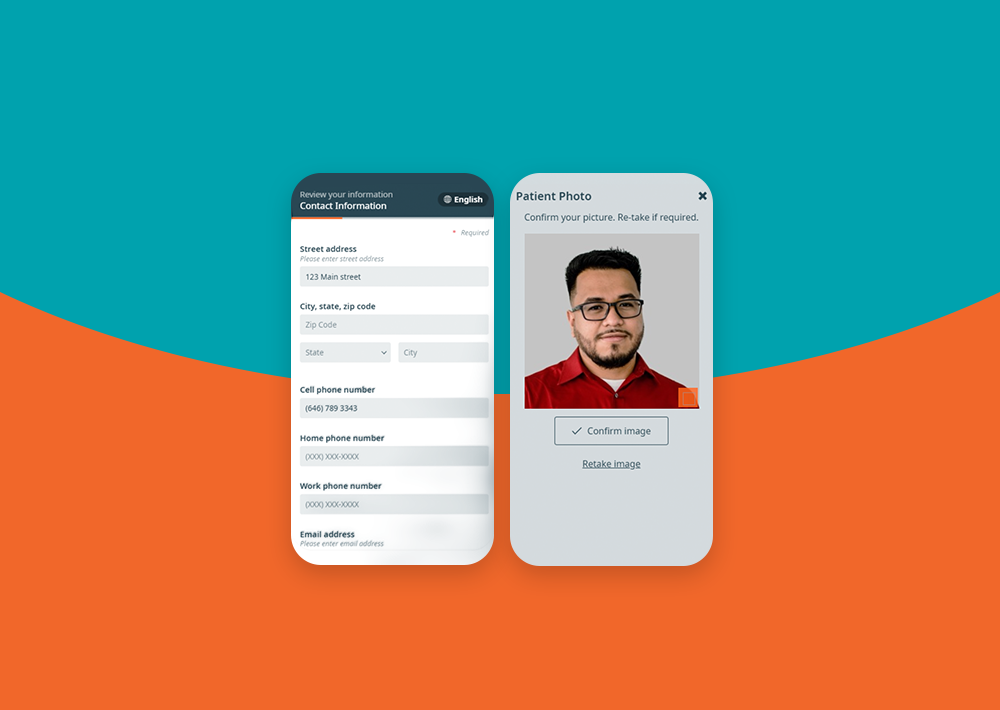
Surveys are customizable and can be modeled after licensed screening tools like CG-CAHPS (designed specifically for outpatient care), so patients complete them online after their visit in the same flow they already use for intake and check-in. Results surface immediately in a real-time dashboard that tracks Net Promoter Score, flags negative responses for immediate follow-up and lets staff close the loop with patients before concerns become public reviews.
Benchmarking against more than 4,700 healthcare organizations nationwide gives your team a clear view of where you stand on the metrics that matter most—appointment availability, operating hours, communication quality—so you can prioritize the improvements with the biggest impact on patient retention and experience scores.
The result: organizations using Phreesia don’t just collect feedback—they respond to it.
Designing a patient survey that produces usable data
A good patient satisfaction survey in healthcare should do one thing well: help you make decisions. If the results won’t change what you do, it’s worth rethinking what you’re asking.
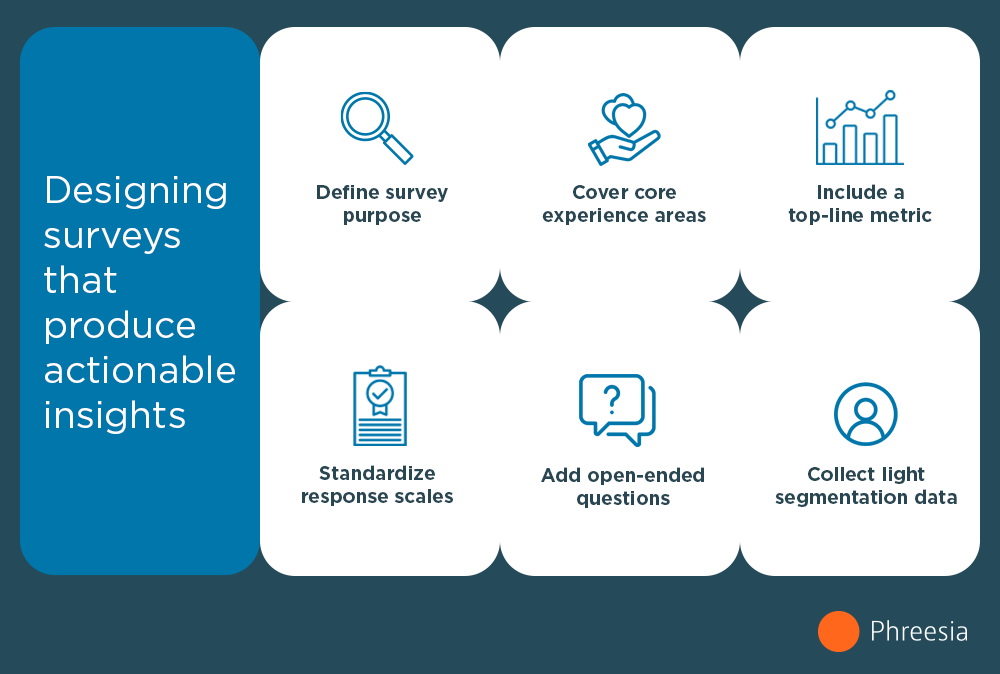
Here’s how to design a survey that delivers clear, actionable insights:
- Start with purpose: Define what decisions the survey will inform. This keeps questions focused and concise.
- Cover the essentials: Include questions on quality of care, access and interpersonal experience.
- Ask an overall question: Add a top-line measure—like overall satisfaction or likelihood to recommend—to track performance over time.
- Use consistent, simple scales: Stick to one rating scale (like 1–5 or 1–10) and keep questions clear and specific.
- Include 1–2 open-ended questions: A simple “What went well?” and “What could we improve?” can uncover insights you might miss otherwise.
Add light context for segmentation: A few demographic or visit-related questions can help identify patterns—just keep it minimal.
Patient feedback survey distribution: channels, timing and sampling
How you send a survey matters just as much as what you ask. The right approach can improve response rates and give you more reliable insights. Here’s how to do it:
- Match the channel to your patients: Choose formats your patients are most likely to use, like SMS, email, phone, mail or a mix (though mobile-friendly options tend to perform best).
- Get the timing right: Send surveys soon enough that the visit is still fresh, but not so quickly that it feels intrusive. A short delay (like later that day or within a few days) is often a good balance.
- Be intentional about sampling: Decide whether you want a broad, representative sample or targeted feedback (for example, from new patients). Both approaches can be useful depending on your goals.
- Plan frequency carefully: Too many surveys can lead to fatigue and lower response rates. Space them out and avoid over-surveying the same patients.
- Make it accessible: Keep surveys easy to read and complete. Offer translations when needed and ensure formats work well on mobile devices.
Increasing patient survey response rates without biasing results
Higher response rates are helpful, but only if the feedback is honest and representative.
“If feedback is influenced or biased, it limits meaningful improvements,” says Guzik. “It also undermines the trust of our patients and families.”
The goal is to make surveys easy to complete without influencing how patients respond. Here’s how to do it:
- Keep it short: Limit the number of questions and set a clear expectation for completion time, says Guzik. The easier it is to finish, the more likely patients are to respond.
- Be transparent about privacy: Let patients know their responses are confidential, she adds. This builds trust and encourages honest feedback.
- Avoid compound questions: Stick to one idea per question. Combining topics makes answers harder to interpret.
- Use reminders thoughtfully: A single follow-up can boost responses without overwhelming patients. Repeated nudges can feel intrusive and lead to lower-quality feedback.
- Keep surveys separate from care delivery: Avoid asking patients to complete surveys during or immediately after care in a way that feels pressured. Feedback should feel voluntary.
- Watch for gaps in responses: Pay attention to who isn’t responding. If certain groups are underrepresented, adjust your outreach to capture a more complete picture.
Analyzing results: from scores to root causes
Collecting survey data is only the first step. The real value comes from understanding what’s driving the results and where to focus next. Here’s how to approach your analysis:
- Look at trends, not just snapshots: Not all feedback carries the same weight, says Guzik. One-off feedback can be misleading, so track results over time to spot patterns tied to seasonality, staffing changes, or workflow shifts.
- Segment the data: Break results down by provider, location, visit type, appointment time or patient group. This helps pinpoint where issues are happening instead of averaging everything together.
- Pair feedback with operational data: Combine survey results with metrics like wait times, visit length, portal use or no-shows. This helps connect patient perceptions to what’s actually happening behind the scenes.
- Turn comments into themes: Open-ended responses often hold the clearest insights. Group similar feedback into themes, track how often they come up and pull example quotes to add context, says Guzik.
- Benchmark thoughtfully: Start with your own baseline and track improvement over time. External benchmarks can be helpful, but only when you’re comparing similar settings and patient populations.
Turning a healthcare satisfaction survey into improvement
Survey results collected are only useful if they lead to change. Here’s how to translate patient satisfaction survey results into action:
- Prioritize what matters most: Focus on issues that come up often and have the biggest impact on the patient experience, says Guzik. Trying to fix everything at once can hinder progress.
- Assign clear ownership: Every improvement effort should have a defined owner, timeline and measurable goal. This keeps work moving and makes progress easier to track.
- Close the loop with patients: Let patients know their feedback was heard and what changed because of it. This builds trust and can improve future response rates.
- Have a service recovery plan: For serious issues, act quickly. Reach out to the patient, escalate when needed and document the resolution so patterns don’t get missed.
- Support your staff: “We know that there’s a strong correlation between high employee engagement and great patient experiences,” says Guzik. “Culture, workforce engagement, communication, quality and safety are strong drivers of patient experience.”
- Re-survey with intention: After making changes, follow up to see if scores and feedback improve. Comparing results over time helps confirm whether changes are working.
Common pitfalls and unintended consequences to avoid
Patient satisfaction surveys are powerful, but they can backfire if they’re poorly designed or used in isolation, according to Guzik. Here are a few common pitfalls to watch out for:
- Measuring what’s easy, not what matters: It’s tempting to focus on simple metrics, but if questions don’t reflect what patients actually care about, the data won’t be useful.
- Focusing on optics over substance: Amenities like waiting room comfort matter, but they shouldn’t outweigh more important issues like clear communication, care coordination and patient safety.
- Encouraging “score chasing”: Tying performance too closely to scores can lead to behaviors that prioritize ratings over appropriate care, including unnecessary appeasement.
- Survey overload: Too many surveys—or surveys that are too long—can lead to lower response rates and disengaged patients, especially if feedback doesn’t lead to visible changes.
- Looking at scores in isolation: Satisfaction scores don’t tell the full story. Without context from comments, trends and operational data, it’s easy to misinterpret what’s actually happening.
The takeaway
- Patient satisfaction surveys reveal how patients perceive their experience, so you can identify gaps and improve care.
- Design and distribution matter: Short, focused surveys sent through the right channels at the right time lead to better response rates and more reliable insights.
- Trends, segmentation, comments and operational data all help explain what’s driving results and where to focus your efforts.
- Prioritize high-impact, recurring issues, assign clear ownership and track progress over time.
- Let patients know their feedback led to change, and follow up on serious issues quickly to close the loop and build trust
- Standardized surveys help you benchmark, while custom surveys help you stay proactive and improve the experience in real time.
Frequently asked questions (FAQs)
What are the 32 HCAHPS questions?
The HCAHPS survey includes 32 items with 22 core questions that measure key parts of the hospital patient experience. These cover areas like: Communication with doctors and nurses
- Staff responsiveness
- Pain management
- Discharge information
- Care transitions
- Hospital environment
It also includes overall rating and likelihood-to-recommend questions, along with a few demographic items.
What are the 5 most common questions you ask a patient?
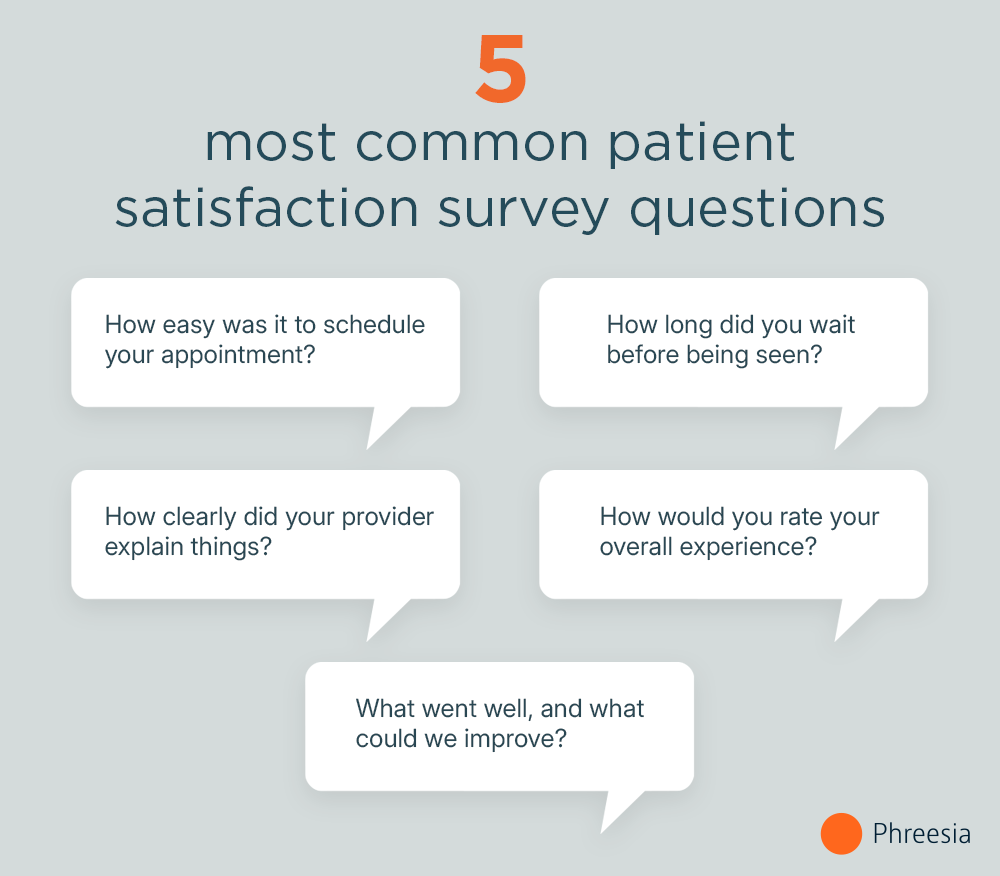
Most patient satisfaction surveys include a mix of rating and open-ended questions that cover quality, access and communication, such as:
- How would you rate your overall experience?
- How clearly did your provider explain things?
- How easy was it to schedule your appointment?
- How long did you wait before being seen?
- What went well, and what could we improve?
What are 7 ways to improve patient satisfaction?
Common ways to improve patient satisfaction include:
- Reduce wait times and improve scheduling access
- Communicate clearly and set expectations upfront
- Show empathy and actively listen to patient concerns
- Simplify billing and explain costs clearly
- Improve care coordination and follow-up
- Make digital tools (like check-in and forms) easy to use
- Act on patient feedback and share what’s changed
What should a patient feedback survey include?
A strong patient feedback survey should include:
- Questions on quality of care, access and communication
- A consistent rating scale (like 1–5 or 1–10)
- One overall satisfaction or likelihood-to-recommend question
- 1–2 open-ended questions for detailed feedback
- Optional demographic or visit context questions for deeper insights
Why is the importance of patient satisfaction surveys increasing?
Patient expectations are higher than ever, and people have more choices for where they get care. At the same time, healthcare patient experience is playing a larger role in how organizations are evaluated and, in some cases, reimbursed. Patient satisfaction surveys help healthcare teams stay competitive by identifying issues early and improving the experience.
Conclusion
Patient satisfaction surveys are only as valuable as what you do with them. The organizations that get this right don’t just collect scores; they build a feedback loop that connects patient perception to daily operations and operational data back to patient experience.
That means designing surveys patients will actually complete, distributing them at the right moment and having a system in place to act on what comes back — quickly, consistently, and at scale.
Done well, surveys don’t just improve scores. They improve retention, strengthen reputation and directly support the financial health of the practice. In a healthcare environment where patient expectations are rising and reimbursement is increasingly tied to experience, that’s not a nice-to-have. It’s a performance lever.
Phreesia helps healthcare organizations close the gap between feedback collected and action taken with real-time alerts, NPS tracking and benchmarking against 4,700+ providers nationwide, all built into the same platform your team already uses for scheduling, intake and payments.
See how Phreesia supports patient satisfaction →
A version of this article was originally published on April 4, 2022.