
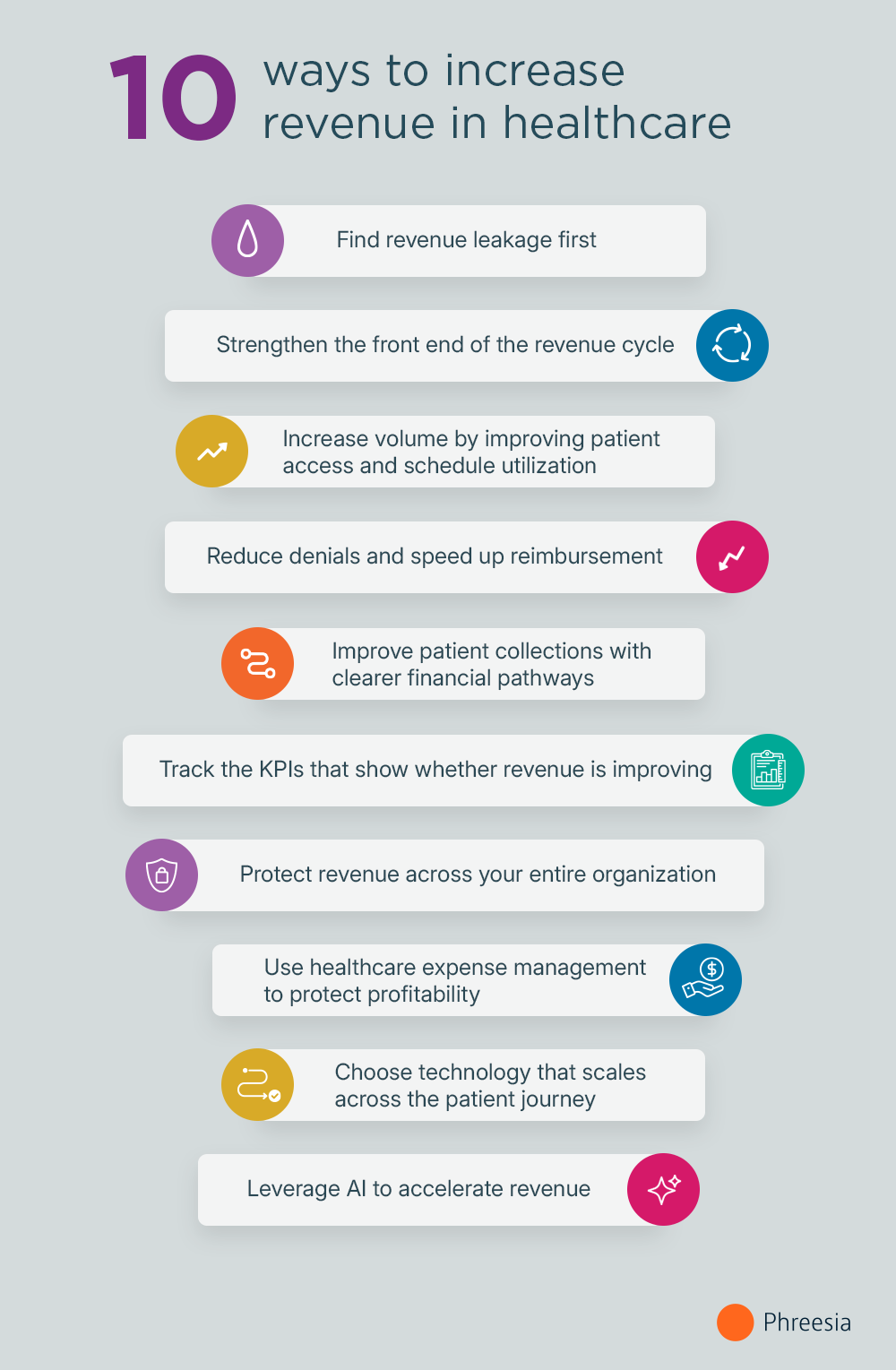
- 1. How to increase revenue in healthcare: find revenue leakage first
- 2. Strengthen the front end of the revenue cycle
- 3. Increase volume by improving patient access and schedule utilization
- 4. Reduce denials and speed up reimbursement
- 5. Improve patient collections with clearer financial pathways
- How Phreesia helps increase revenue in healthcare
- 6. Track the KPIs that show whether revenue is improving
- 7. How to protect revenue across your entire organization
- 8. Use healthcare expense management to protect profitability
- 9. Choose technology that scales across the patient journey
- 10. Leverage AI to accelerate revenue performance
- The takeaway
- Frequently asked questions (FAQs)
- Conclusion
Author: Kathleen Ferraro | Expert review by: Briana Kearney
When it comes to increasing revenue in healthcare, the fastest gains usually come from fixing what’s already leaking, not adding more volume. Missed collections, no-shows, denied claims and patient churn quietly drain revenue at every stage of the patient journey. The most effective approach is to tighten those workflows—from scheduling through follow-up—so more of the revenue you’ve already earned actually gets collected.
Healthcare organizations are under pressure from both rising costs and revenue that’s harder to collect. Recent data shows operating margins hovering around 1%—and even dipping into the negatives—as expenses continue to outpace revenue. It’s no surprise, then, that more teams are asking how to improve revenue in healthcare.
For many teams, the issue isn’t getting more patients—it’s collecting the revenue tied to the visits you already have. Revenue performance depends on what happens across the entire patient journey. When something breaks down, revenue slips through the cracks.
This quick guide breaks down where revenue leaks, what to tackle first and how to measure what’s working.
1. How to increase revenue in healthcare: find revenue leakage first
Before you fix revenue, you need to see where it’s slipping. Start by separating the two types of leakage:
- Direct leakage: Revenue you’ve earned but haven’t collected (missed copays, unpaid balances, denied or unreimbursed claims)
- Indirect leakage: Revenue you never had the chance to earn (no-shows, empty slots, patient churn)
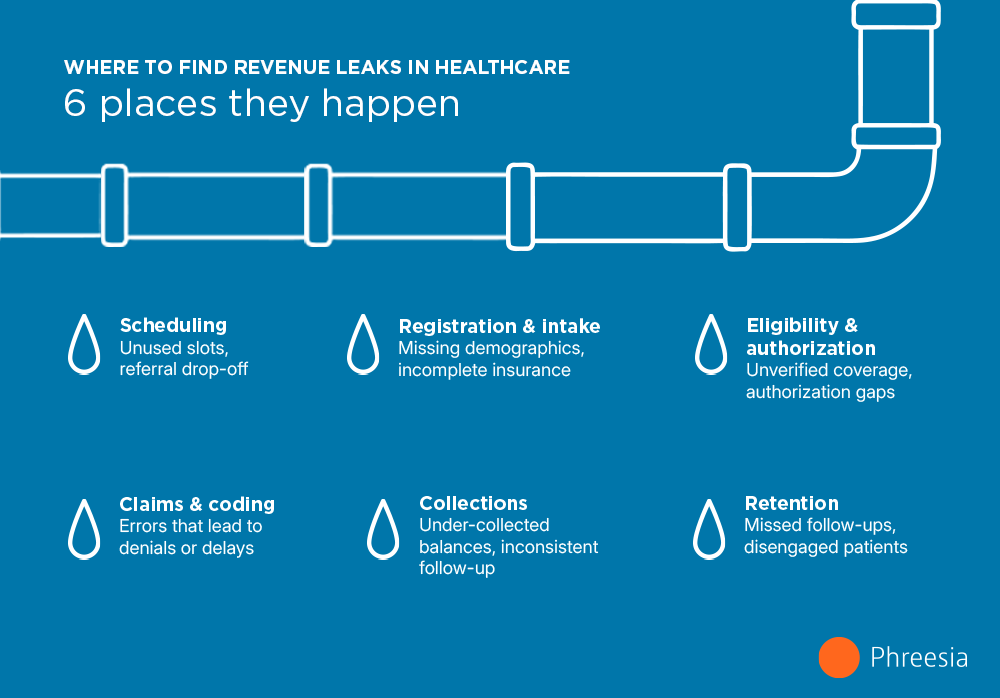
According to Amanda Hein, Director of Revenue Cycle Management at NorthShore Health Centers, both show up across the same core workflows:
- Scheduling (unused slots, referral drop-off)
- Registration and intake (missing demographics, incomplete insurance)
- Eligibility and authorization (unverified coverage, authorization gaps)
- Claims and coding (errors that lead to denials or delays)
- Collections (under-collected balances, inconsistent follow-up)
- Retention (missed follow-ups, disengaged patients)
Once you know where leakage can happen, the next step is identifying where it’s happening most in your organization. Look for patterns by location, specialty, or workflow—one site may struggle with no-shows, while another loses revenue at the point of service.
From there, prioritize the leaks that are most frequent, most expensive, or easiest to fix. Small improvements in high-volume workflows can quickly start to generate more revenue.
2. Strengthen the front end of the revenue cycle
Whether you’re running an emergency department, outpatient clinic, ambulatory surgery center or a multispecialty group, one thing is true across every care setting: a strong revenue cycle starts before the visit. When front-end processes break down—during scheduling, registration or eligibility verification—those errors don’t stay contained. They show up later as denied claims, rework, and delayed payments regardless of where care was delivered.
The fix is simple in theory: Get it right early. According to Hein, that means:
- Capturing accurate patient data at scheduling and registration
- Verifying insurance and eligibility before the visit
- Confirming authorizations to prevent denials
- Standardizing intake workflows across teams and locations
When patient data is accurate from the start, it reduces downstream billing errors, rework, and preventable denials.
And when patients understand their coverage and expected costs upfront, they’re more likely to pay (and less likely to be surprised later).
Standardizing these workflows across teams and locations helps ensure that same level of accuracy and consistency everywhere, not just in pockets of the organization.
3. Increase volume by improving patient access and schedule utilization
“No-shows and underutilized schedules reduce revenue by leaving potential billing opportunities unused,” Hein says. Indeed, empty slots, cancellations and slow scheduling workflows all translate into lost short-term revenue and long-term growth.
The goal: Make it easy for patients to book—and keep—their appointments.
Hein recommends focusing on a few high-impact areas:
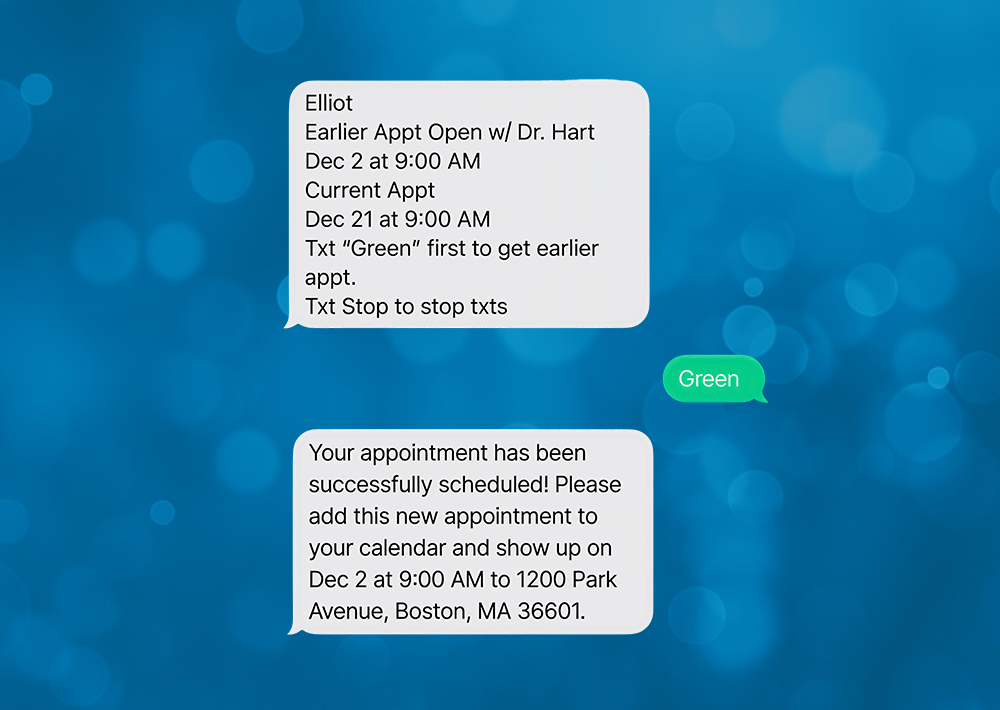
- Reduce no-shows with automated reminders (text, email, call)
- Fill cancellations quickly with smart waitlists or same-day scheduling
- Offer convenient access points, like online booking
- Streamline referral intake to reduce drop-off
- Re-engaging overdue patients and improving follow-up scheduling
4. Reduce denials and speed up reimbursement
“Many preventable denials stem from operational issues, including unverified or outdated eligibility, missing or incomplete authorizations, coding errors, insurance filing gaps and COB issues,” Hein says.
These denied or delayed claims slow cash flow and create extra work your team has to chase down later.
Fortunately, Hein says a few fixes go a long way. These include:
- Verifying eligibility and benefits before the visit
- Confirming authorizations
- Improving coding accuracy through training and clear documentation
- Using claim edits or scrubbing tools to catch errors before submission
- Tracking denials by payer, department, and root cause to spot—and fix—patterns early
- Following up on a denied or delayed claim quickly (the longer it sits, the harder it is to get paid)
5. Improve patient collections with clearer financial pathways
Patient responsibility now makes up a bigger share of healthcare revenue—and it’s often the hardest to collect. If the process feels confusing or inconvenient, payments get delayed or missed.
The fix: Make paying as straightforward as possible. Hein suggests focusing on these areas:
- Collect at the point of service whenever possible
- Offer digital payment options like online portals, mobile pay, and text-to-pay
- Send clear, easy-to-understand billing communications
- Provide flexible payment options for larger balances
Ultimately, clarity goes a long way. When patients understand what they owe, why they owe it, and how to pay, they’re much more likely to follow through.
And it’s a win-win: A smoother payment experience helps you collect more and makes the process easier on patients.
How Phreesia helps increase revenue in healthcare
In order to stop revenue leaks, your practice needs cleaner intake, fewer no-shows, faster eligibility and higher collections — which is exactly what Phreesia was built to fix more than 20 years ago. Not as a collection of separate tools, but as one connected platform where what happens at scheduling protects revenue at claims, and what happens at intake determines what gets collected after the visit.
Here’s how it works across the patient journey:
- Scheduling & Access: Empty slots and no-shows are the first place revenue leaks. Phreesia’s AI-powered scheduling keeps schedules full with 24/7 self-scheduling, automated reminders that drive a 78% reduction in no-shows, and Appointment Accelerator—a smart waitlist that fills cancellations automatically in under 5 minutes and recaptures an average of $30,000 in lost revenue every month.
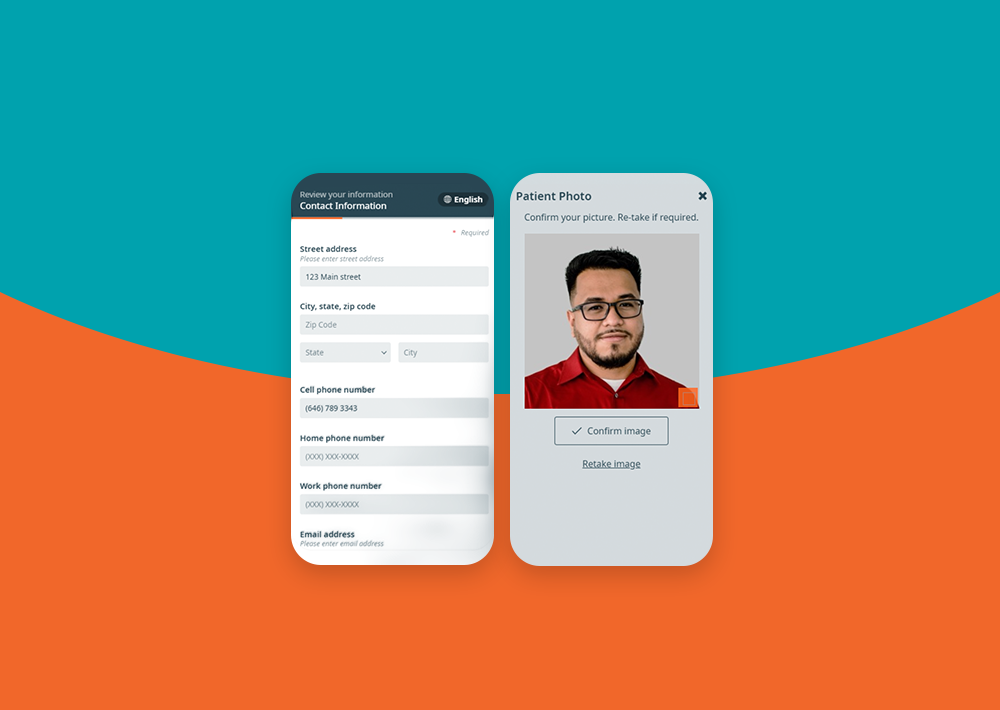
- Intake & Registration: Clean data at intake means clean claims downstream. Nearly 1 in 4 denied claims traces back to a registration or eligibility error at the front end. Phreesia catches those mistakes before the visit, capturing accurate patient demographics, insurance information and consent before the patient ever walks through the door—reducing the front-end errors that cause denials and rework later. Practices using Phreesia capture 3x more patient-reported data compared to manual processes.
- Eligibility & Authorization: Unverified coverage is one of the most preventable sources of denied claims. Phreesia’s AI-driven eligibility checks run before the visit so coverage gaps are caught early—not after care has already been delivered.
- Patient Collections: Patient responsibility is now one of the largest—and hardest to collect—portions of healthcare revenue. Phreesia makes paying as easy as possible with text-to-pay, mobile pay, credit cards on file and flexible payment plans. The result? Within 6 months of implementing Phreesia, practices see an average 73% increase in time-of-service collections—meaning more revenue is collected before the patient ever leaves the building. Phreesia customers also collect 89% of copays (compared to an industry average of 56%) and 86% of patient balances through self-service, without a single staff member making a call or chasing a payment.
See why 4,700+ healthcare organizations trust Phreesia to make the revenue tied to every patient visit actually get collected.
6. Track the KPIs that show whether revenue is improving
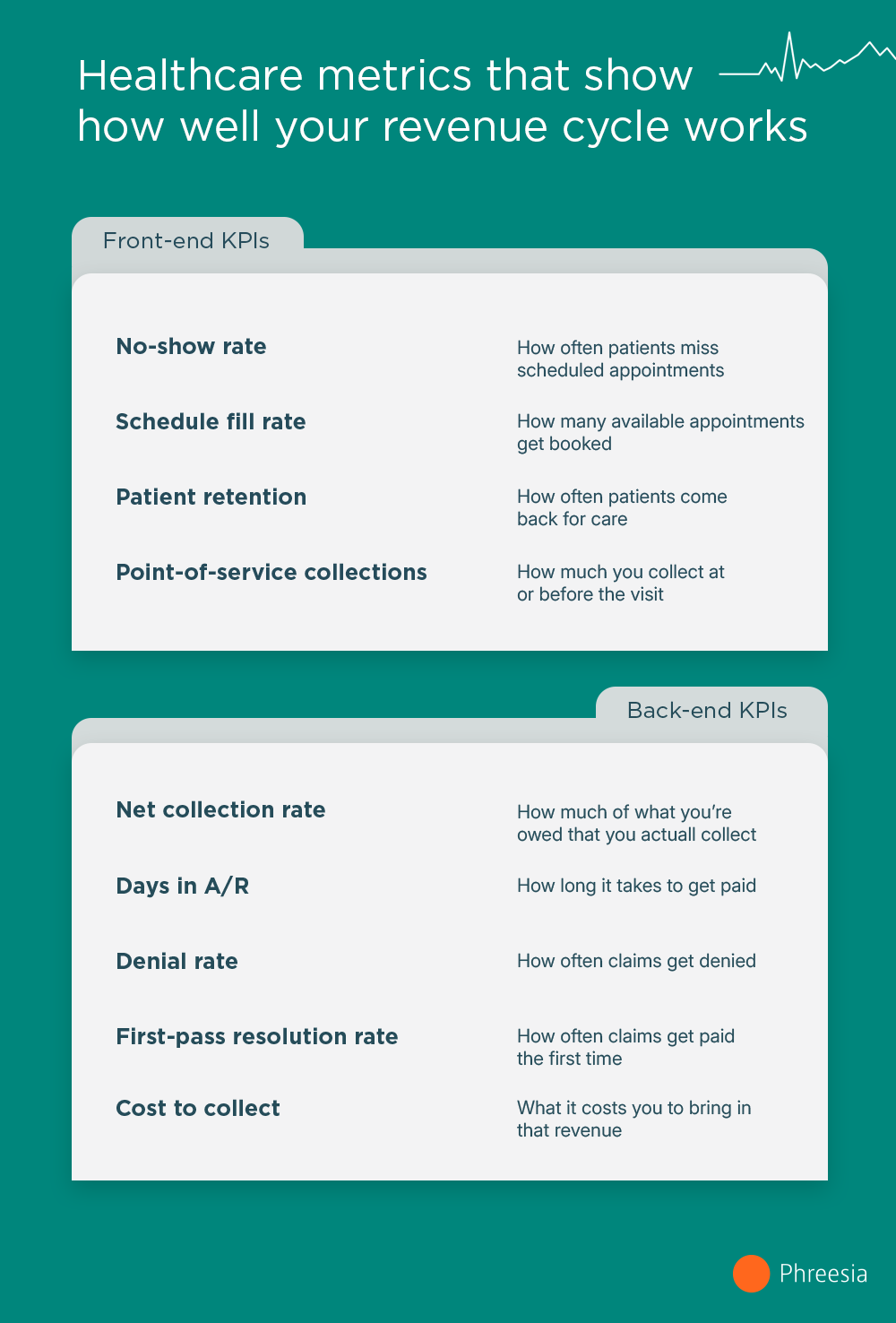
You can’t improve what you don’t measure. But tracking everything isn’t the goal. Instead, a focused set of KPIs gives you a clear view of where revenue is improving and where it’s still leaking.
Hein recommends starting with core revenue cycle metrics, like:
- Net collection rate: How much of what you’re owed that you actually collect
- Days in A/R: How long it takes to get paid
- Denial rate: How often claims get denied
- First-pass resolution rate: How often claims get paid the first time
- Cost to collect: What it costs you to bring in that revenue
These show how well your back-end processes are performing, but they’re only part of the picture. To understand what’s driving those results, you also need to track what’s happening earlier in the patient journey, including:
- No-show rate: How often patients miss scheduled appointments
- Schedule fill rate: How many available appointments get booked
- Patient retention: How often patients come back for care
- Point-of-service collections: How much you collect at or before the visit
“Together, these metrics give a clear picture of how well the entire revenue cycle is functioning,” says Hein. “[They] help identify issues early so they can be corrected before they turn into lost revenue.”
From there, look for patterns by site, specialty, or workflow, and use real-time reporting when possible so teams can act quickly. A small set of well-tracked KPIs makes it easier to spot issues early and focus on what actually moves the needle.
7. How to protect revenue across your entire organization
Whether you’re running a single-specialty practice, a multispecialty group or a health system with dozens of ambulatory locations, the same revenue principles apply: capture the full value of the care you’re already delivering and make sure nothing slips between the cracks as patients move through your system.
For larger organizations, that means paying attention to a few additional pressure points:
- Patient flow and capacity utilization: Delays in scheduling, slow referral intake or gaps in care coordination limit how many patients you can see—and how quickly. Streamlining access across locations and service lines keeps schedules full and reduces the revenue lost to inefficiency.
- Documentation and coding: Incomplete or inconsistent documentation leads to undercoding, missed charges and preventable denials—whether you’re a two-provider practice or a 200-provider health system. Clear, accurate documentation at the point of care supports appropriate reimbursement and reduces rework downstream.
- Follow-up and care continuity: Missed follow-ups don’t just affect outcomes; they affect revenue. Patients who don’t return for follow-up care represent lost visits, lost billing opportunities and weaker long-term retention. Automated outreach and proactive scheduling close those gaps before they become revenue leaks.
The biggest impact comes from connecting these stages across your organization. When scheduling, intake, documentation and follow-up are aligned—whether across one location or fifty—you’re better positioned to boost revenue, reduce leakage and protect margins.
8. Use healthcare expense management to protect profitability
Increasing revenue is only part of the equation. Protecting margins also means taking a closer look at where time and resources are getting drained.
A lot of that comes down to everyday inefficiencies—manual work, duplicate tasks, and inconsistent workflows that slow teams down and pull focus away from higher-value work. Here’s how to start closing those gaps:
- Reduce manual processes
- Cut duplicate work across teams and systems
- Standardize workflows to improve consistency
- Review vendor and tech spend to make sure it’s actually delivering value
This is where automation can really help. “Automation eliminates repetitive tasks, allowing teams to focus on other revenue-driving tasks,” Hein says. “Work queues help teams efficiently prioritize high-dollar claims, rather than randomly working on accounts.”
Less wasted work and spend means more time for the work that impacts revenue without sacrificing quality of care.
9. Choose technology that scales across the patient journey
At a certain point, improving revenue comes down to having the right systems in place. The key is choosing technology that solves real problems, not adding more tools for the sake of it.
Start by mapping where revenue is leaking. Is it happening at scheduling, intake, eligibility, payments or follow-up? Let that guide what you prioritize.
Then look for digital tools that increase revenue by supporting the full patient journey, such as:
- Registration and intake that capture accurate data upfront
- Scheduling and access that reduce no-shows and fill open slots
- Eligibility and authorization checks to prevent downstream issues
- Patient payment tools that make it easier to collect balances
- Reporting and analytics that surface performance gaps in real time
Just as important is how well your systems work together. Tools that integrate cleanly are easier for staff to use and reduce manual work. So as you evaluate options, focus on:
- Usability for staff and patients
- Clear visibility into performance
- Measurable ROI tied to your biggest gaps
Start small, track results, and build from there. For many healthcare organizations looking to increase revenue, this is where a technology partner like Phreesia can help bring these workflows together and drive more consistent results.
10. Leverage AI to accelerate revenue performance
AI is changing how healthcare organizations approach revenue—not by replacing the fundamentals, but by making each step faster, more accurate and more automated.
Across the patient journey, AI-powered solutions are already driving measurable gains:
- Smarter scheduling and waitlist management: AI identifies eligible patients and fills canceled slots automatically, recapturing revenue that would otherwise be lost without any staff involvement.
- Proactive eligibility and denial prevention: AI-driven eligibility checks run before the visit, catching coverage gaps and registration errors before they become denied claims. Nearly 1 in 4 denials traces back to a front-end error; AI catches those before they cost you.
- Automated patient collections: AI-powered outreach contacts patients about outstanding balances via text, email and voice under your practice’s number, securely, in the background. No staff time required.
- Intelligent call handling: AI voice agents handle billing calls, payment collection and scheduling conversations automatically, reducing call volume while keeping revenue flowing. Healthcare organizations using Phreesia VoiceAI report a 30% decrease in patient billing calls.
Phreesia’s AI-powered platform connects all of these capabilities in one place so the gains compound across every touchpoint rather than staying isolated in a single workflow.
The takeaway
- Most revenue gains come from fixing what’s already leaking, not just bringing in more patients.
- The biggest gaps usually show up across the same touchpoints: scheduling, intake, eligibility, claims, collections and retention.
- Getting the front end right sets everything else up: cleaner claims, fewer denials and faster payment.
- Making it easier for patients to book, understand costs and pay goes a long way for both revenue and retention.
- A small, focused set of KPIs helps you spot issues early and see what’s actually working.
- The right mix of workflows and technology reduces friction and helps you capture more of the revenue you’ve already earned.
Frequently asked questions (FAQs)
What is the best way to increase revenue in healthcare?
Start by fixing what’s already leaking. That usually means tightening front-end workflows like scheduling, registration, and eligibility, reducing denials on the back end, and making it easier for patients to understand and pay their bills. Small improvements across these areas can add up quickly.
How can healthcare organizations improve revenue cycle performance?
Focus on the full workflow, not just one piece of it. Verifying insurance early, capturing accurate patient data, and standardizing intake help prevent issues later. On the back end, tracking denials, improving coding accuracy, and following up quickly on claims help speed up payment.
What metrics matter most for healthcare revenue?
You don’t need dozens of metrics—just the right ones. Core KPIs include net collection rate, days in A/R, denial rate, first-pass resolution rate, and cost to collect. It’s also helpful to track operational metrics like no-show rate, schedule fill rate, patient retention, and point-of-service collections.
What is the largest source of revenue for healthcare organizations?
Most revenue comes from inpatient and outpatient care. How much of that revenue is actually collected, however, depends on how well the organization manages scheduling, billing, and follow-up. Improving the healthcare revenue cycle comes down to tightening those workflows.
What technology has the biggest impact on revenue growth?
Technology that improves how work gets done across the patient journey tends to have the biggest impact. That includes tools for scheduling, eligibility, intake, payments, and reporting. The most effective solutions reduce manual work, improve accuracy, and give teams a clearer view of performance.
Conclusion
Revenue growth in healthcare comes down to how well your workflows hold together across the patient journey. Small breakdowns—at scheduling, intake, eligibility, claims, or collections—can quietly add up.
The biggest gains usually come from tightening those gaps and connecting the dots. When access, revenue cycle, payments, and reporting are working together, it’s easier to capture more of the revenue tied to each visit and cut down on rework.
Start by identifying where revenue is leaking, fix a few high-impact areas, and track what changes. With the right processes and tools in place, revenue improvement becomes more predictable—and a lot more manageable.
A version of this article was published on February 20, 2024.