
Revenue challenges in healthcare rarely come down to one issue. More often, they’re the result of small breakdowns across the patient journey—an incomplete registration here, a missed eligibility check there—that lead to denials, delays and lost revenue.
That’s where revenue cycle management in healthcare comes in. It connects patient access, clinical workflows, billing and collections into one continuous process, from scheduling to final payment.
Today, that process spans more teams and touchpoints than ever. Front-end staff handle scheduling, registration and insurance capture. Mid-cycle teams support documentation and coding. Back-end teams manage claims, denials and collections. And leaders need clear visibility across it all to understand where revenue is moving (and where it isn’t).
Below, we’ll break down what revenue cycle management is, how it works and the workflows that help organizations get paid faster.
Revenue cycle management in healthcare: what it means and why it matters
Revenue cycle management(this link opens in new window) in healthcare is the process of tracking and collecting payment for care. It spans from the moment a patient schedules their visit through the final payment.
It starts earlier than most people think. The healthcare revenue cycle begins with scheduling, registration and insurance capture. It then moves through eligibility checks and authorizations before reaching documentation, coding, billing and collections.
The finish line is full reimbursement from both the payer and the patient.
When healthcare revenue cycle management is working well, the path from care to payment is smoother. Accurate data at the front end leads to cleaner claims, fewer denials and faster payment. Teams spend less time fixing errors and more time moving revenue forward.
When it breaks down, small issues early on tend to follow the claim all the way through. Missing insurance details or skipped eligibility checks can turn into denials, delays and extra work on the back end, according to Amanda Hein, director of revenue cycle management at NorthShore Health Centers(this link opens in new window).
Strong revenue cycle management supports more than cash flow. It helps organizations stay compliant, reduce financial risk and create a clearer, more manageable payment experience for patients.
Why the healthcare revenue cycle is more complex today
Healthcare revenue cycle management has always required coordination. But today, there are more variables, handoffs and pressure to get it right the first time.
Several factors are driving that complexity, including:
- Higher patient financial responsibility(this link opens in new window): More revenue now depends on patient payments, not just payer reimbursement. With higher deductibles and cost-sharing, upfront cost clarity and easy payment options play a bigger role in whether organizations get paid.
- More payer rules and prior authorization requirements(this link opens in new window): Eligibility criteria, authorization workflows and documentation standards continue to evolve. Even small gaps can lead to denials or delays.
- Greater pressure to reduce denials and rework: Denials are costly and often preventable. Many stem from issues like missing eligibility checks or incomplete data, creating extra work that could have been avoided earlier, says Hein.
- More systems and workflow fragmentation(this link opens in new window): Scheduling platforms, EHRs, billing systems and clearinghouses don’t always connect efficiently. Each handoff creates another opportunity for errors or missing information.
- Rising expectations for a better patient financial experience: Patients expect clear pricing(this link opens in new window), simple check-in and convenient ways to pay. When that experience falls short, collections often do too.
Together, these shifts make the healthcare revenue cycle more complex and raise the stakes for getting each step right.
What are the stages of the healthcare revenue cycle?
The healthcare revenue cycle is typically grouped into three stages: front end, mid-cycle, and back end. Each builds on the one before it, which means issues early in the process tend to carry through to the final payment. Here’s the breakdown.
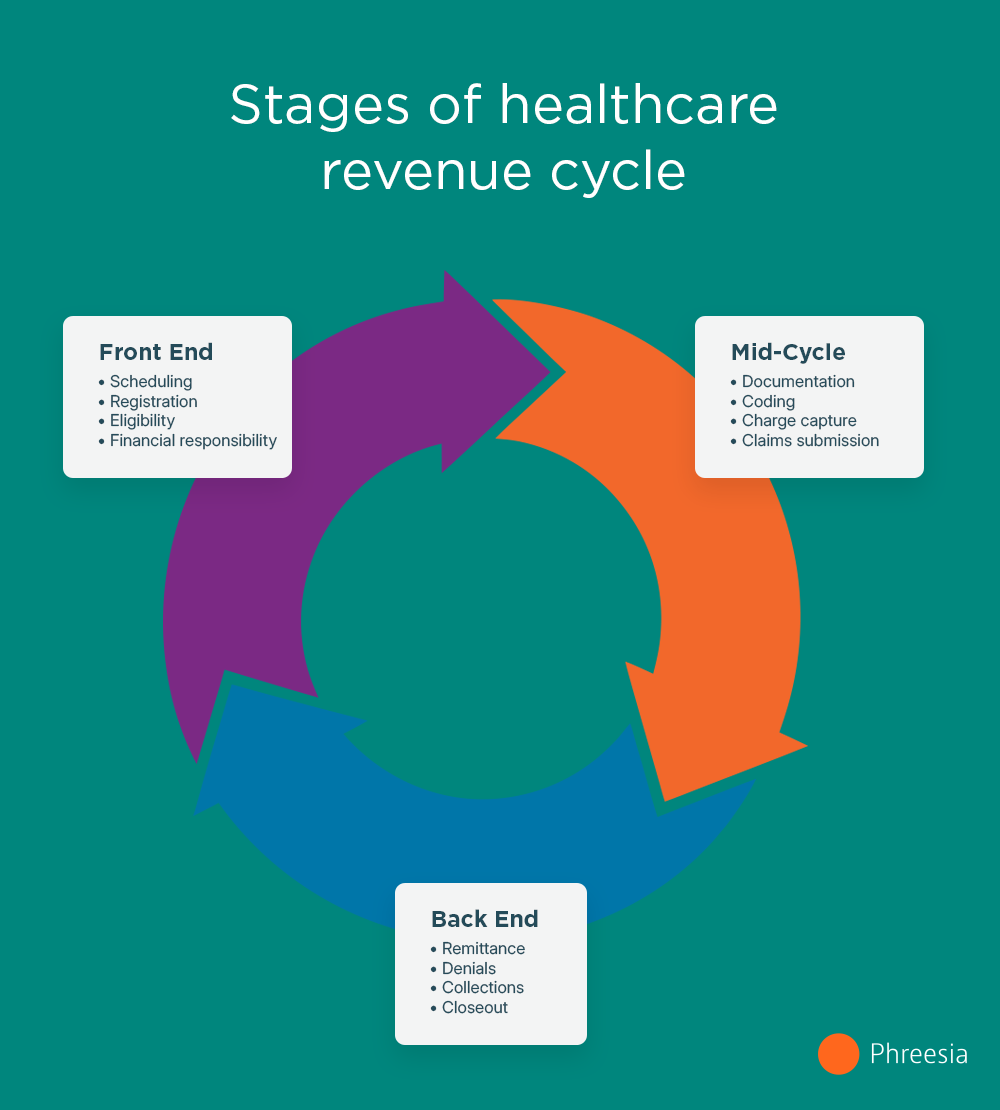
Front end
This is where the revenue cycle begins—and, according to Hein, where many of the most preventable issues show up:
- Scheduling: Capturing accurate appointment details and patient information from the start
- Registration: Collecting and confirming demographics, insurance information and contact details
- Insurance verification: Confirming active coverage, benefits and patient responsibility before the visit
- Prior authorization: Ensuring required approvals are in place for services that need them
- Financial responsibility conversations: Helping patients understand expected costs and payment options ahead of time
Mid-cycle
The mid-cycle focuses on translating care into billable services. Accuracy during these steps directly affects whether claims are accepted, delayed or denied:
- Documentation: Recording services accurately in the clinical record
- Coding: Assigning the correct medical codes based on documentation
- Charge capture: Ensuring all billable services are accounted for
- Claims submission: Sending claims to payers with complete and accurate information
Back end
The back end is where payment is finalized—and where delays often become visible. According to Hein, this phase includes:
- Remittance posting: Recording payer payments and adjustments
- Denial management: Identifying, correcting and resubmitting denied claims
- Patient collections: Collecting outstanding balances from patients after insurance processing
- Reconciliation and closeout: Ensuring accounts are fully resolved and balances are accurate
Where medical revenue cycle management commonly breaks down
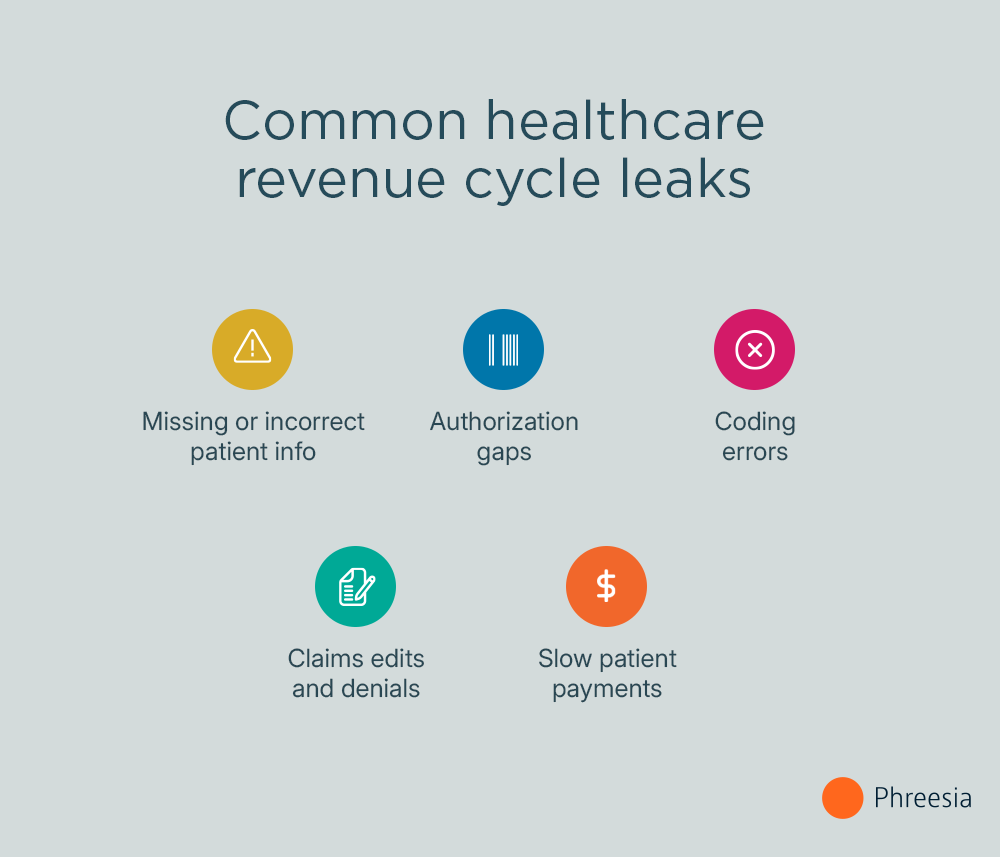
Even well-run organizations see revenue leakage. But in most cases, it traces back to a few common breakdowns across the healthcare revenue cycle. According to Hein, these include:
- Incomplete or inaccurate patient data: Missing or incorrect demographic and insurance information at registration can follow a claim all the way through the cycle. Even small errors—like a misspelled name or outdated policy number—can lead to rejections or delays.
- Missed eligibility or authorization checks: Skipping or rushing eligibility verification and prior authorization is one of the fastest ways to create preventable denials. If coverage isn’t confirmed upfront, claims are more likely to be denied later.
- Coding and charge capture errors: Incomplete documentation or incorrect coding can result in underbilling, overbilling or claim rejections. These errors often require time-consuming corrections and resubmissions.
- Claim edits and denial bottlenecks: Without strong claim scrubbing and review processes, errors make it through to submission. Once a claim is denied, teams often have to work it manually, which slows down payment and increases workload.
- Slow patient collections after claims processing: Collecting from patients after the visit is often more difficult and less predictable. Without clear upfront communication and convenient payment options, balances can linger or go unpaid.
- Limited visibility into workflow issues: When teams don’t have clear reporting or insight(this link opens in new window) into where breakdowns are happening, problems tend to repeat. Research(this link opens in new window) shows that gaps in data visibility and system usability can disrupt workflows and make it more difficult to track performance or identify root causes.
Revenue cycle monitoring: the KPIs that matter most
You can’t improve what you can’t see. Revenue cycle monitoring gives organizations a clear view into how revenue is moving and where it’s slowing down.
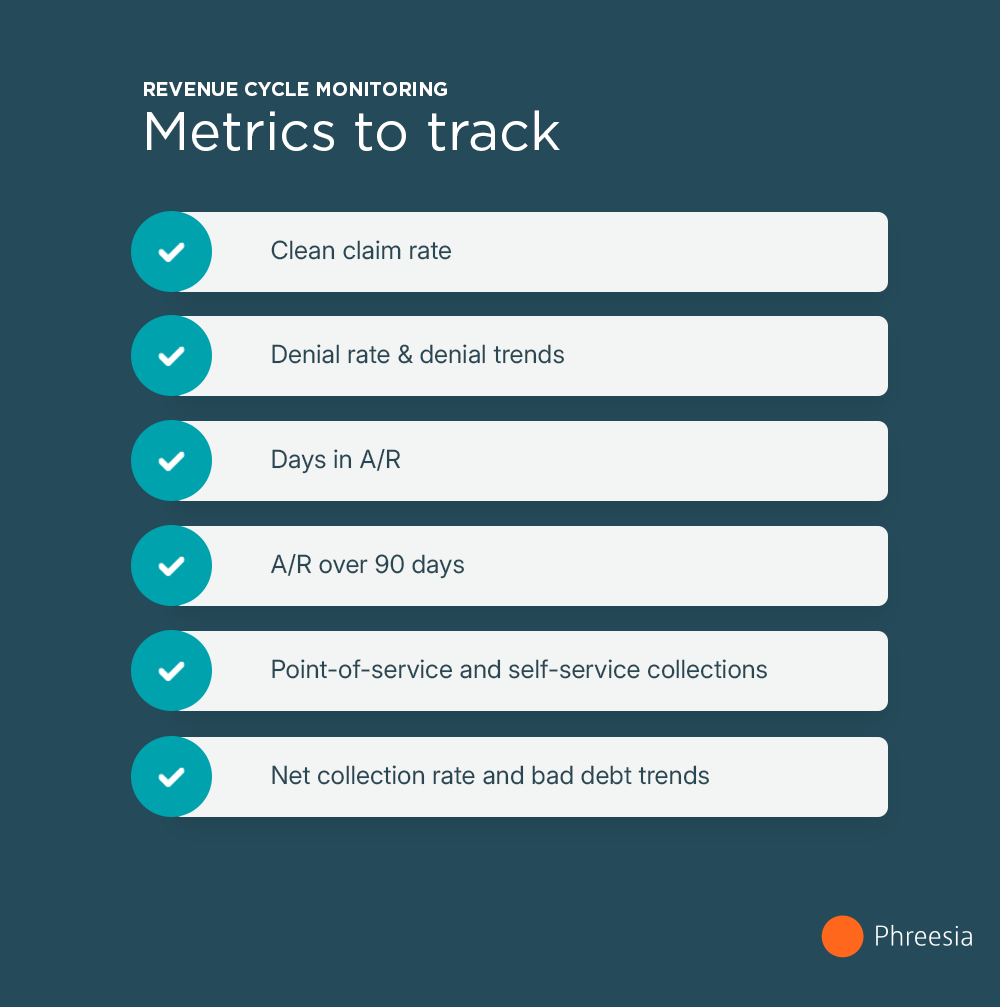
While there are dozens of metrics teams can track, “focus on key KPIs that reveal organizational performance,” explains Hein. She says a handful of metrics tend to tell the most complete story, including:
- Clean claim rate: The percentage of claims that are accepted on the first submission without errors. A higher rate typically signals strong front-end processes and accurate coding.
- Denial rate and denial trends: How often claims are denied, and why. Tracking trends over time helps teams identify root causes, whether it’s eligibility issues, authorization gaps or coding errors.
- Days in A/R: The average number of days it takes to collect payment after a claim is submitted. Lower days in A/R generally indicate a more efficient revenue cycle.
- A/R over 90 days: The portion of accounts receivable that remain unpaid after 90 days. Higher percentages can point to issues with follow-up, collections or claim resolution.
- Point-of-service and self-service collections: How much revenue is collected upfront or through digital channels. Strong performance here often reflects clear patient communication and convenient payment options.
- Net collection rate and bad debt trends: Net collection rate shows how much of the total expected reimbursement an organization actually collects. Paired with bad debt trends, it helps highlight gaps between billed and collected revenue.
How technology supports healthcare revenue cycle management
Technology plays a key role in making the healthcare revenue cycle more consistent, accurate and easier to manage.
“Automation eliminates repetitive tasks, allowing teams to focus on other revenue-driving tasks,” explains Hein. For example:
- Automate registration and insurance capture: Digital intake tools can reduce manual data entry and ensure patient information is complete and accurate from the jump.
- Run eligibility and benefits checks before visits: Automated eligibility verification helps confirm coverage and patient responsibility ahead of time.
- Improve copay collection and bill pay convenience: Tools like online payments, mobile check-in and text-to-pay make it easier for patients to pay.
- Support claim accuracy and reduce manual follow-up: Claim scrubbing tools can catch errors before submission, while work queues help teams prioritize high-value claims.
- Use dashboards and reporting for revenue cycle monitoring: Centralized reporting gives teams visibility into KPIs, making it easier to spot issues and act quickly to protect revenue from cuts.
How AI Is changing revenue cycle management
Automation has long helped revenue cycle teams handle repetitive tasks. AI takes that further—not just executing steps, but understanding context, making decisions and improving over time. The shift happening across the industry right now is significant: AI is moving from flagging problems to closing them, from single-step automation to connected workflows, and from reactive to predictive.
Here’s where that shift is showing up most clearly across the revenue cycle:
- From flagging issues to resolving them: Early automation surfaced errors and alerts for staff to act on. AI identifies the right answer and acts on it automatically, reducing the manual work that used to sit between a flag and a fix.
- Smarter eligibility and benefits verification: AI can now cross-reference coverage data, identify discrepancies and validate patient responsibility earlier in the process—reducing the front-end errors that most commonly lead to denied claims downstream.
- Automated patient collections and outreach: AI identifies patients with outstanding balances and initiates outreach through the right channel at the right time, improving collection rates without increasing staff workload.
- Conversational AI for billing and scheduling: AI voice agents are increasingly handling inbound and outbound calls related to billing questions, balance collection and appointment scheduling, freeing staff from high-volume, routine interactions so they can focus on higher-complexity work.
- Connected intelligence across the cycle The most meaningful AI gains aren’t coming from individual tools—they’re coming from platforms where AI has context across the full patient journey. When each step knows what preceded it, the system gets smarter at every handoff and revenue cycle performance compounds over time.
Revenue cycle management services vs. in-house workflow improvement
When organizations look to improve performance, they often consider revenue cycle management services—outsourced support for functions like billing, coding or collections.
These services can help fill gaps, especially for teams managing high volumes or limited resources. In some cases, they bring specialized expertise and help speed up turnaround times.
But outsourcing doesn’t fix upstream issues. That’s why many organizations focus on strengthening internal processes(this link opens in new window) alongside any external support to prevent issues before they require rework.
In practice, the most effective approach often combines both: stronger front-end workflows supported by the right revenue cycle management tools, with services layered in where they add the most value.
How patient access and patient payments shape revenue performance
A lot of increasing your healthcare organization’s revenue comes down to two things: how patients are onboarded, and how easy it is for them to pay. Here’s where that impact shows up most clearly:
- Better scheduling and registration improve downstream accuracy: When patient information is captured accurately upfront, everything that follows gets easier, says Hein.
- Earlier insurance checks reduce preventable denials: Verifying coverage and benefits before the visit helps teams catch issues early.
- Upfront financial clarity can reduce billing surprises: When patients don’t understand what they owe, billing becomes more confusing(this link opens in new window) and harder to navigate—making it more difficult to collect payments.
- Convenient payment options can improve collections: Making it easy to pay has a direct impact on whether patients follow through, according to Hein. Features such as mobile wallets, card-on-file with auto-pay and self-service payment plans reduce friction and meet patients where they are.
- Automated prompts and follow-ups keep payments moving: Surfacing copays and balances during intake—and following up with digital reminders after the visit—helps ensure payments don’t fall through the cracks.
Phreesia’s data reinforces how much this matters in practice. Organizations using Phreesia’s Patient Bill Pay collect payments 1 to 7 days after billing (instead of 30 to 90 days when the work is done manually), and collect 4x faster overall. They also see 15% higher collections and 90% more revenue from self-service payments within the first two months.
Just as importantly, these tools reduce the burden on staff(this link opens in new window). Digital billing, automated reminders and centralized dashboards streamline collections while giving patients a simpler, more flexible way to pay.
Best practices for improving revenue cycle performance
Improving revenue cycle performance usually comes down to making key workflows more consistent and easier to execute across teams. As Hein’s insights suggest, improving performance often comes down to a few main areas:
- Standardizing front-end data capture: Consistent processes for collecting demographics, insurance details, and contact information help reduce avoidable errors before they spread downstream.
- Reviewing denials by root cause, not one by one: Instead of fixing individual claims, look for patterns. Identifying the underlying issue—whether it’s eligibility, authorization or coding—helps prevent repeat denials.
- Track KPIs consistently and share them across teams: Metrics like denial rate, days in A/R, and point-of-service collections are most useful when they’re reviewed regularly and visible across teams.
- Tighten handoffs between teams: Breakdowns often happen between patient access, clinical documentation, billing and collections. Clear ownership and communication reduce delays and rework.
- Use automation for repetitive, high-risk tasks: Automating eligibility checks, payment reminders and claim edits helps reduce manual errors and frees up staff time.
- Revisit workflows as payer rules change: Payer requirements evolve(this link opens in new window) constantly. Regular updates help teams stay compliant and avoid preventable issues.
The bottom line
Revenue cycle management works best when it’s treated as a connected system rather than a series of separate tasks. Each step, from scheduling through collections, builds on the one before it. When workflows are consistent and coordinated, organizations are more likely to accelerate revenue. When they’re not, small issues can compound into delays, denials and extra work.
The biggest gains often come from tightening how information is captured, shared and acted on across the cycle—especially at the front end and in patient payments. With the right workflows and tools in place, organizations can reduce friction, improve visibility and create a more predictable path from care delivery to payment.
Frequently asked questions
The revenue cycle management (RCM) cycle in healthcare refers to the full process of tracking and collecting payment for care. It runs the gamut from scheduling and registration through billing, reimbursement and patient payment.
The primary goal is to ensure organizations are paid accurately and on time for the care they provide. That includes minimizing denials, reducing delays and improving both payer reimbursement and patient collections.
Revenue cycle management supports financial stability, operational efficiency and compliance. It also plays a growing role in the patient experience, especially as more costs shift to individuals.


