Featured
Early Access: Faster insight into insurance coverage with AI
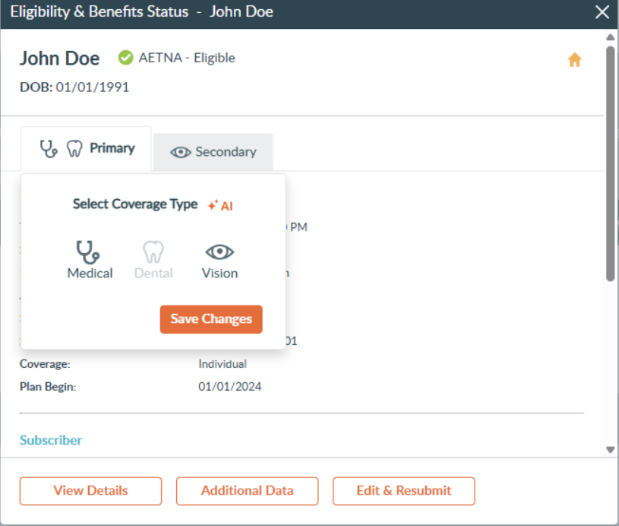
What’s new: As part of the Enhanced Insurance Coverage early access program, Phreesia now uses AI to classify insurance coverage as medical, dental, or vision and display an icon next to each insurance entry. Users can update the coverage type to improve accuracy over time.
How this helps you: Staff can quickly identify coverage types without reviewing 271 responses or accessing payer portals, helping streamline eligibility workflows and reduce errors that can lead to claim denials.
Want early access to Enhanced Insurance Coverage?
VoiceAI is now fully integrated for eMDs and Oracle Health organizations
What’s new: VoiceAI is now fully integrated with Oracle Health and eMDs. This release includes patient matching for incoming calls, visibility into relevant patient information, and automatic export of call notes and transcriptions into the EHR.
How this helps you: Care teams can quickly identify callers, access the right patient context, and avoid manual documentation—helping improve after-hours workflows, reduce administrative effort, and deliver more informed patient interactions.
Next step: This is now available for all Oracle Health and eMDs clients using VoiceAI.
Interested in optimizing your VoiceAI setup?
Communication
Built-in team messaging with VoiceAI Team Chat
What’s new: Phreesia VoiceAI Team Chat enables secure, HIPAA-compliant messaging between staff members within the same practice and now supports group conversations with up to 50 participants—up from the previous limit of five.
How this helps you: Staff can communicate quickly and securely without leaving the VoiceAI dashboard. Teams can collaborate more effectively by keeping larger groups in a single conversation, reducing fragmented messaging and simplifying coordination across departments or locations.
More accessible patient emails
What’s new: Phreesia enhanced the accessibility of patient email templates with improved color contrast, larger interactive elements, visible focus indicators, and descriptive alternative text in default templates.
How this helps you: This makes emails to patients easier to read and interact with—supporting patients with visual, motor, or cognitive impairments.
Next step: This is applied automatically for all patient emails through Phreesia.
More predictable delivery for Health Campaigns
What’s new: Health Campaigns now send at system-managed speeds based on size and capacity. The option to manually select a sending speed has been removed, so you no longer have to manage or fine-tune delivery settings.
How this helps you: This update takes the guesswork and manual effort out of campaign delivery. Instead of managing individual sends or worrying about timing, Phreesia handles delivery automatically; ensuring campaigns go out reliably, at the right pace, and without delays. Campaigns send as follows:
- Fewer than 100 patients: messages begin immediately
- 100–50,000 patients: delivery typically completes within 2 hours
- More than 50,000 patients: delivery typically completes within 6 hours
Next step: This update applies automatically to all clients using Health Campaigns.
Registration
Capture more registrations with automatic follow‑up
What’s new: Phreesia now automatically sends a Final Attempt Check-In message to patients who were manually checked in but haven’t completed registration, giving them an additional opportunity to finish intake.
How this helps you: This helps increase registration completion while reducing the need for manual staff follow-up, creating a more efficient check-in process and a smoother patient experience.
Next step: This feature will be enabled for clients that aren’t using it today.
Phreesia Library
Phreesia offers a library of standardized tools and best-practice content designed to align with industry recommendations and increase completion rates. These pre-built modules can be seamlessly added to your existing intake workflows. Organizations that use these modules see a 9.5% lower drop rate, and patients complete interviews 48.8% faster compared to custom content.
We deploy new and updated content with every release.
Standardized tools
We now offer the following clinically validated patient-reported outcomes (PROs).
Dizziness Symptom Profile
This structured 31-item assessment standardizes how dizziness symptoms are captured, scored, and interpreted during intake—helping to reduce variability across visits and providers.
Falls Efficacy Scale (FES)
A validated 10-item self-report measure that assesses fear of falling by evaluating a patient’s confidence in performing everyday activities.
Falls Efficacy Scale–International (FES-I)
A validated 16-item assessment that expands on the FES to measure concern about falling across both physical and social activities, including more challenging tasks.
Alcohol and Substance Use Screening Questionnaire (AUDIT-C Plus 2)
Combines the validated AUDIT-C alcohol screener with two additional questions on marijuana use and illegal or non-medical prescription drug use—providing broader substance use insight in a single workflow.
PRAPARE (2025)
The latest version of the Protocol for Responding to and Assessing Patients’ Assets, Risks, and Experiences (PRAPARE), updated to align with current national standards for capturing social determinants of health (SDOH).