
A strong patient acquisition strategy does more than bring people to your website. It helps them take the next step—booking care—without confusion, delays or extra effort.
At its core, patient acquisition(this link opens in new window) is the process of attracting new patients and guiding them from initial interest to a completed visit. That includes how easily patients can find you online, how simple it is to access care and how smoothly they move through scheduling, intake and follow-up.
It’s also closely tied to retention. The same factors that help someone book their first appointment—clear information, easy access and timely communication—are often what bring them back.
That’s why patient acquisition marketing can’t sit in a silo. It has to connect with the operational workflows that shape the patient experience day-to-day.
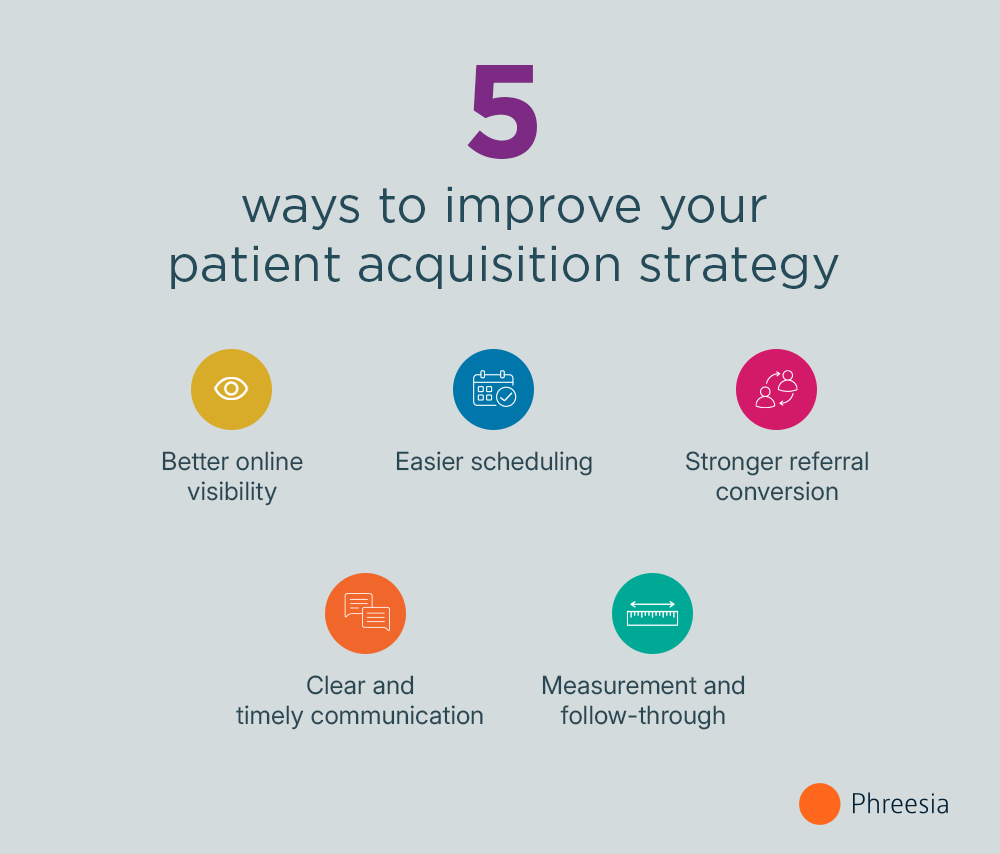
In this article, we’ll break down five practical ways to improve your patient acquisition strategy, including:
- Better online visibility
- Easier scheduling
- Stronger referral conversion
- Clear and timely communication
- Measurement and follow-through
Together, these levers reflect how acquisition actually happens across the patient journey, plus where small improvements can lead to more booked appointments without adding more work for your team.
Patient acquisition strategy starts with the right foundation
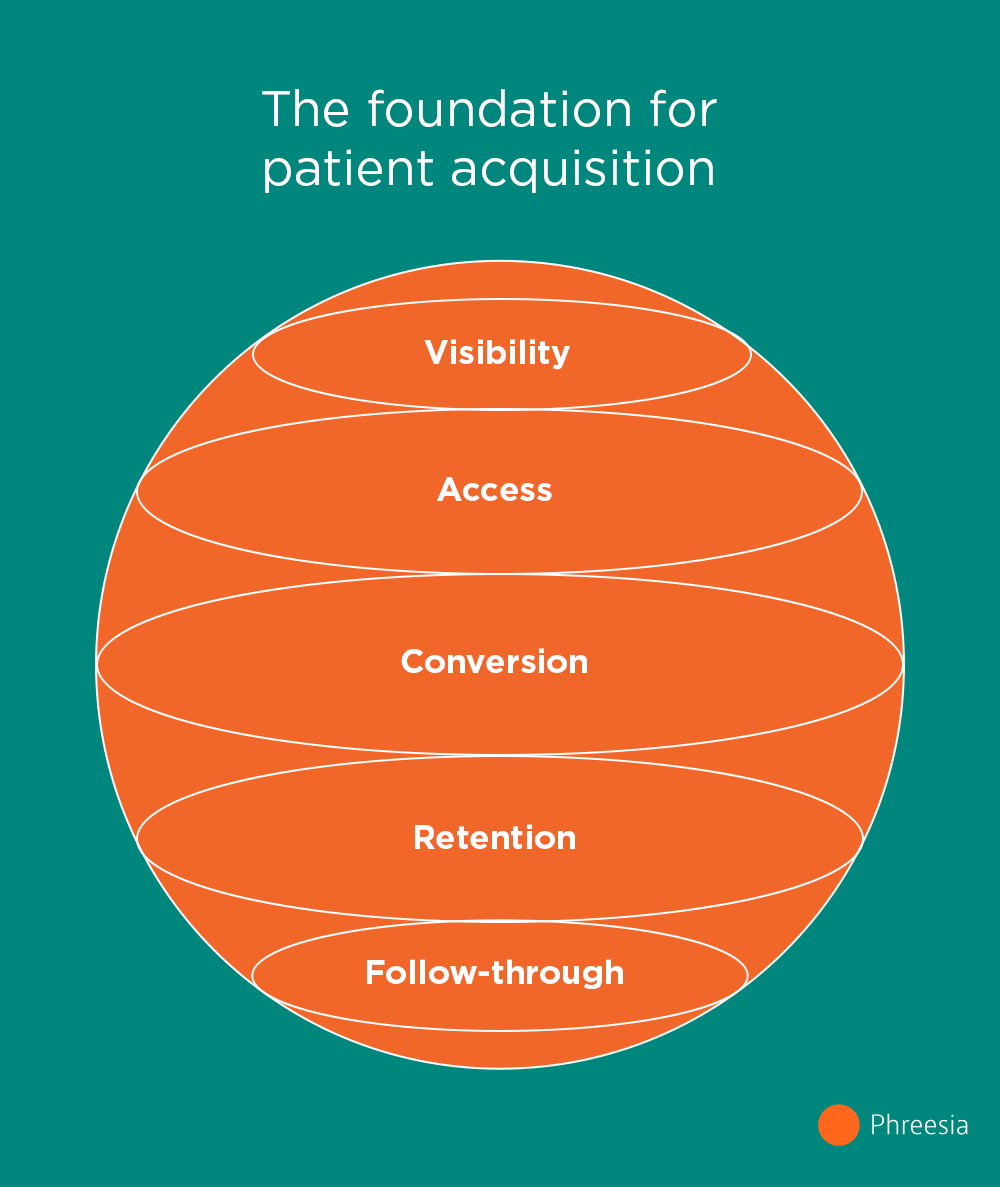
A patient acquisition strategy works best when it’s built around how patients actually move through the healthcare experience. At a practical level, that strategy includes a few connected pieces(this link opens in new window):
- Visibility: Can patients find you when they’re searching for care?
- Access: Can they quickly see availability and understand how to book?
- Conversion: Can they move from interest to a scheduled appointment without friction?
- Retention: Do they have a positive experience that brings them back?
- Follow-through: Are there systems in place to keep patients engaged after that first visit?
When any one of these steps breaks down, new patient acquisition becomes harder(this link opens in new window). For example, a patient might find your organization online, but hit a dead end trying to schedule. Or they might get referred, but never hear back in time to book. All that to say: The demand is often there, but the experience creates friction that slows everything down—or shuts it down entirely.
That’s why patient acquisition strategies need to go beyond marketing campaigns. They should connect directly to the workflows that shape access, scheduling and communication behind the scenes.
And the most effective patient marketing strategy is one that reduces effort on both sides. Patients can quickly find what they need and take action, while staff spend less time chasing paperwork, managing manual follow-ups or filling gaps in the process.
1. Improve online visibility and reputation to support patient acquisition marketing
For many patients, the search for care starts online. And it’s often quick: just a few searches, a handful of tabs and a decision. What they find in those first moments can determine whether they move forward or move on.
That first impression is built on a few key elements, including:
- Online reviews: This is key—up to 60% of people(this link opens in new window) rely on reviews when choosing a provider. In addition to star ratings, patients are looking for signals that others felt heard, respected and cared for. A steady stream of recent, authentic feedback can quietly tip the scale in your favor.
- Provider profiles: Patients want to quickly understand who they’ll be seeing, what conditions are treated and whether the provider takes their insurance. When that information is incomplete, outdated or buried, it creates friction at the moment patients are trying to make a decision.
- Your website: This is your digital front door. Your site should clearly explain services, locations and insurance coverage, and make next steps obvious. If patients have to hunt for basic details or figure out on their own how to book, many won’t stick around.
Across all of these touchpoints, accuracy and consistency matter more than most teams realize. When provider details, availability and insurance information line up across your website, search listings and third-party platforms, it makes things feel clear and dependable from the start. That goes a long way in building trust.
Patient satisfaction surveys and review generation can build on that over time. When you’re regularly collecting feedback(this link opens in new window) and making it easy for satisfied patients to share their experiences, it adds a layer of credibility that feels genuine.
2. Make new patient acquisition easier with online scheduling
Online scheduling(this link opens in new window) often makes the difference between a patient booking or not booking at all.
Put yourself in the patients’ shoes: They’ve just decided they want care. Maybe they’re on your website or they found you through search. They’re ready to act. But if the only option is to call during business hours, wait on hold or remember to follow up later, that momentum can disappear quickly.
In fact, most patients don’t want to call(this link opens in new window). They want to book right then and move on with their day. And if they can’t, many won’t come back.
That’s why online scheduling is such a powerful driver of new patient acquisition. It meets patients in the moment they’re ready and gives them a clear next step.
“Don’t overcomplicate the questions that you ask through online self-scheduling,” advises Amy Williamson, director of clinical operations at Bluegrass Orthopaedics(this link opens in new window). “Think about it from a patient perspective, not the provider’s perspective.”
Where you place scheduling matters just as much as offering it in the first place. It should be easy to find anywhere a patient might decide to book, including:
- Your website
- Provider profiles
- Search listings
- Social channels
The experience itself also needs to feel connected and easy. When scheduling interfaces directly with your EHR and shows real-time availability(this link opens in new window), patients can book with confidence and staff don’t have to spend time cleaning up mismatched appointments or playing phone tag.
“Make it clear and easy for patients,” says Williamson. “Have a platform that makes it simple to schedule online and doesn’t require them to call your office with follow-up questions.”
3. Turn referrals into booked appointments faster
Patient referrals are one of the strongest signals of intent you can get. By the time a patient is referred, they already know they need care and are ready to take the next step.
But ironically, that’s often where things slow down.
In many organizations, referral workflows(this link opens in new window) are still pretty manual. Paper forms, e-faxes, disconnected systems and delayed follow-up can create friction at exactly the wrong moment. Referrals sit in queues, staff have to track down missing details and patients are left waiting or wondering what they’re supposed to do next.
From the patient’s perspective, that’s confusing(this link opens in new window). They’ve been told to schedule, but don’t always know how, when or with whom. Some will follow up. But others get busy, lose track or start looking elsewhere. And those missed connections can quickly turn into lost visits—and revenue.
The good news is, small changes can make a big difference. When referral workflows are centralized(this link opens in new window) and easier to track, teams can quickly see what’s moving and what’s stuck. That makes follow-up more timely and a lot less manual.
It also helps to give patients a clearer path forward. Instead of waiting for a call, they can be guided to schedule sooner, with fewer steps and less uncertainty.
And when referrals move smoothly, it shows. Patients get into care faster, staff spend less time chasing information and more of those high-intent referrals turn into actual visits.
4. Match the patient experience to your patient marketing strategy
A strong patient marketing strategy sets expectations(this link opens in new window). So the experience that follows should live up to them.
“[This] establishes trust early on in the experience, which translates to trust in the practitioners and staff,” explains Williamson.
For instance, if a patient finds you through a polished website or a clear message about easy access, they expect that same level of clarity when they try to book, complete forms or follow up. When those pieces don’t match, it creates friction and distrust—and that can determine whether they move forward or come back.
This is where acquisition and retention start to overlap. Yes, the first visit is about getting someone in the door. But it’s also about making the experience smooth enough that they want to come back.
A few elements make a big difference here:
- Timely communication: This helps patients understand what to expect and what to do next, reducing uncertainty.
- Clear next steps: Clarity makes scheduling, intake and follow-up easier to navigate without confusion.
- Easy intake: When pre-visit tasks can be done quickly online or on a mobile device, patients are more likely to follow through.
- Thoughtful touchpoints: Things like well-timed reminders, simple pre-visit forms and clear follow-up messages help the experience feel smooth and connected.
5. Measure what your patient acquisition strategies are actually driving
It’s easy to focus on activity: more campaigns, more traffic, more referrals. But if you’re not tying that back to booked appointments, it’s hard to know what’s actually working.
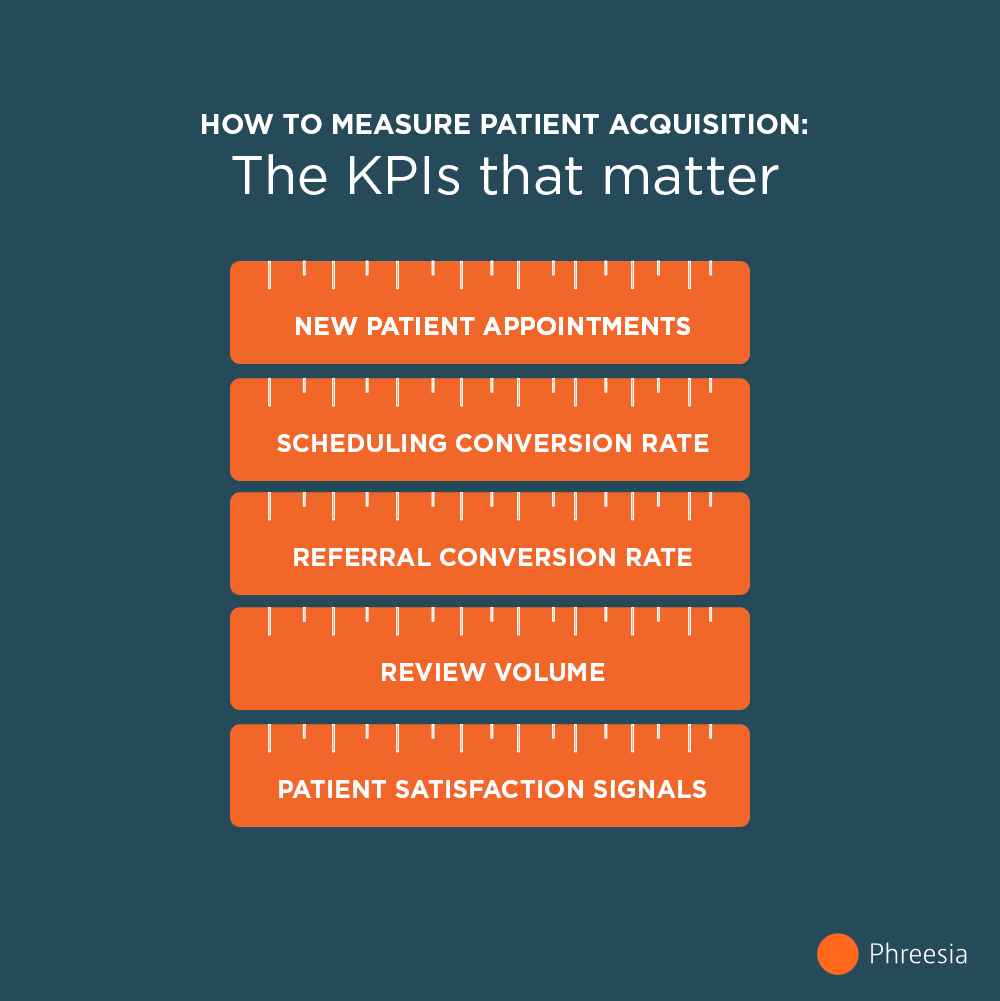
According to Williamson, a strong patient-centric acquisition and appointment strategy comes down to a few key metrics that connect effort to outcomes:
- New patient appointments: How many first-time visits are being scheduled
- Scheduling conversion rate: How often patients who start booking actually finish
- Referral conversion rate: How many referred patients turn into scheduled visits
- Review volume: Whether you’re consistently building feedback and visibility
- Patient satisfaction signals: What patients are saying about their experience
Looking at these together helps you quickly spot where things are breaking down. Strong traffic but low scheduling conversion? There may be friction in the booking experience. High referral volume but low conversion? Follow-up may be too slow or inconsistent.
It’s also worth looking beyond volume into what’s actually driving growth. While some channels may bring in more patients overall, others bring in patients who are more likely to follow through and stay engaged(this link opens in new window).
When you measure across the full journey, it becomes much easier to adjust what’s not working. Often, small changes—like making scheduling easier or tightening referral follow-up—can lead to more booked visits.
How AI is changing patient acquisition
Automation has helped healthcare organizations streamline scheduling and outreach for years. Now, AI is taking that a step further(this link opens in new window) by helping teams make smarter decisions across the entire patient journey.
Here’s how:
- Converting interest, not just capturing it: Traditional digital tools helped organizations generate leads and appointment requests. AI can now help identify which patients are most likely to schedule, personalize follow-up and reduce the drop-off that happens between interest and action.
- Smarter scheduling and access: AI-powered scheduling tools can help match patients with the right provider, location or appointment type faster, while also helping organizations optimize availability and reduce gaps in the schedule.
- More proactive referral management: AI can help prioritize referrals, identify delays and surface patients who may be at risk of falling through the cracks, helping teams follow up sooner and move patients into care faster.
- More personalized outreach and engagement: AI can support more targeted communication based on patient preferences and behavior, so outreach feels more relevant and timely.
- Conversational AI for scheduling and patient access: AI voice and chat tools are increasingly helping patients schedule appointments, ask questions and navigate next steps without waiting on hold or relying entirely on staff availability.
- Connected intelligence across the patient journey: The biggest gains come from connected systems that understand what’s happening across scheduling, referrals, communication and follow-up. When those pieces work together, organizations get a clearer view of where patients are getting stuck and how to keep them moving forward.
The bottom line
A strong patient acquisition strategy makes it easier for patients to move forward. When patients can find you, understand their options and book without jumping through hoops, more of that initial interest turns into real appointments. And when the experience feels smooth from the start, they’re much more likely to come back.
The organizations seeing the most consistent growth are simply connecting the dots—making sure visibility, scheduling, referrals and follow-up all work together. In most cases, the demand is already there. When the path to booking is clear, everything else starts to fall into place.
Frequently asked questions
Online scheduling gives patients a simple, immediate way to book care when they’re ready. By removing the need to call or wait for office hours, it reduces drop-off and helps more patients follow through with scheduling.
Referrals are one of the clearest signals that a patient is ready for care. But if the process feels slow or unclear, it’s easy for that momentum to stall. When referral workflows are more streamlined, it’s much easier for patients to follow through and get scheduled.
Patient acquisition focuses on attracting new patients and getting them to book their first visit. Patient retention focuses on keeping patients engaged over time. In practice, the two are closely connected, since a smooth first experience often leads to ongoing care.


