
Patient referrals are a core part of how care moves forward. The process starts with a clinical need and should end with a scheduled visit, completed care and a clear update back to the referring provider. But in practice, that handoff often stretches across multiple systems, teams and touchpoints. And that’s where things can start to break down.
Maybe referrals come in by fax, but no one tracks them. Or patients are told to schedule an appointment, but aren’t sure where to start. In other cases, key details are missing, forcing staff to follow up before anything can move forward.
The impact adds up quickly, leading to delayed access to care, disrupted continuity and more administrative work for teams that are already stretched thin.
These patterns are consistent. But fortunately, they’re also fixable. Below, we break down three common patient referral process pain points and how to fix them.
Patient referrals: why the process breaks down
On paper, the patient referral process is simple: identify a need, connect the patient to the right provider and complete the handoff. In reality, it’s spread across multiple teams, systems and steps–each with its own chance for things to slow down or fall through, according to Amy Williamson, director of clinical operations at Bluegrass Orthopaedics(this link opens in new window).
And those gaps directly affect whether patients actually get care. Research(this link opens in new window) shows that breakdowns in the referral process can lead to delays, missed appointments and lost follow-up, especially when communication between providers isn’t consistent.
At the same time, expectations have changed(this link opens in new window). Patients want clear next steps and faster scheduling without having to manage the process themselves. And for healthcare organizations, referrals(this link opens in new window) play a major role in access, growth and how effectively specialty care is used.
Here are the three biggest patient referral pain points–and how to fix them.
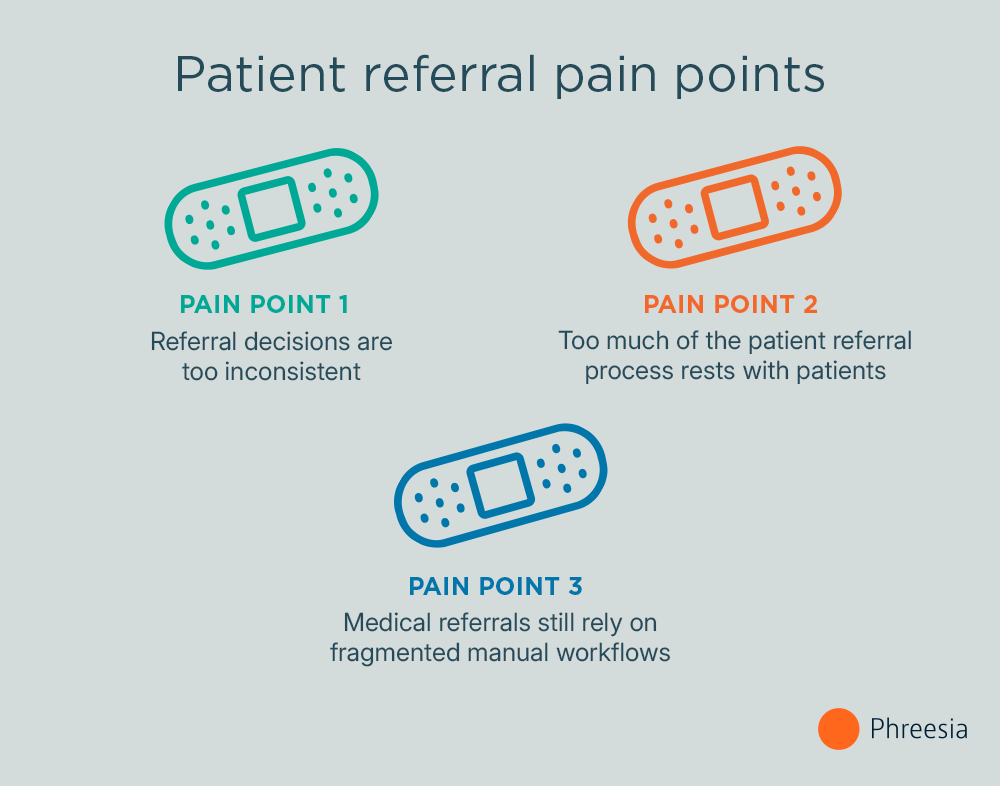
1. Referral decisions are too inconsistent
In many organizations, referral decisions(this link opens in new window) are shaped more by habit than by a consistent process. One provider may always refer to the same specialist. Another might base the decision on who they know. Over time, that variability creates a referral process that’s hard to manage and even harder to optimize.
Inconsistent physician referrals create extra work on both sides. Staff(this link opens in new window) need to clarify where referrals should go, check insurance and track down missing details. Patients(this link opens in new window) are left to figure out next steps, schedule on their own and fill in gaps between providers.
Standardizing referral decisions(this link opens in new window) helps remove that friction. Instead of relying on memory or personal preference, providers have a clearer path to follow. That starts with defining clear criteria by specialty, including factors like:
- Urgency
- Location
- Payer requirements
- Patient preferences
From there, building structured referral pathways and maintaining an up-to-date provider directory can make the right next step much easier to identify.
And the impact shows up quickly: More consistent referral patterns(this link opens in new window) reduce back-and-forth, improve intake quality and make the handoff between providers feel more coordinated for patients.
2. Too much of the patient referral process rests with patients
Even when a referral is made, the process often doesn’t move forward unless the patient does the work(this link opens in new window) to keep it going, notes Williamson. They may need to:
- Call and schedule
- Respond to follow-ups
- Navigate between offices to get everything lined up
Each added step creates another opportunity for delays. And even when patients intend to follow through, it’s easy for things to stall. The result is a gap between referral intent and actual scheduled care.
Reducing that gap starts with shifting more ownership back to the organization. Instead of relying on patients to initiate the next step, teams can guide the process forward(this link opens in new window) by:
- Scheduling at the point of referral, so patients leave with a clear next step
- Reaching out proactively to book visits and keep referrals moving
- Routing referrals into a structured follow-up workflow to avoid drop-off
- Sending timely updates, reminders(this link opens in new window) and clear instructions so patients know exactly what to expect
3. Medical referrals still rely on fragmented manual workflows
Even when referral decisions are clear and patients are supported, the process can still break down behind the scenes. Many organizations manage medical referrals, says Williamson. This occurs across a mix of fax, phone calls, paper forms and disconnected systems(this link opens in new window) without a single place to track what’s happening.
That fragmentation creates a set of consistent referral challenges. And together, they make the workflow hard to track (and even harder to scale):
- Referrals arrive through multiple channels, but aren’t centralized
- Staff have to check different systems to find or track referrals
- Key details are often missing, requiring follow-up before scheduling
- There’s limited visibility into referral status or next steps
A more effective approach starts by bringing everything into one place. Instead of managing referrals across inboxes, faxes and spreadsheets, leading organizations:
- Consolidate referral intake into a single, centralized workflow
- Automatically capture and organize referral data(this link opens in new window) from any source
- Standardize required fields so referrals arrive complete
- Route referrals into clear work queues for faster action
From there, visibility improves across the board. Teams can:
- Track referral status in real time
- Identify which referrals are ready to schedule
- Flag missing information early
- Follow up on open referrals, cancellations or no-shows
What a stronger patient referral process looks like
When referral workflows improve, the difference is clear. Referrals move with more direction, less back-and-forth and fewer missed steps, says Williamson. And everyone involved has a clearer understanding of what happens next.
Here’s how to do it:
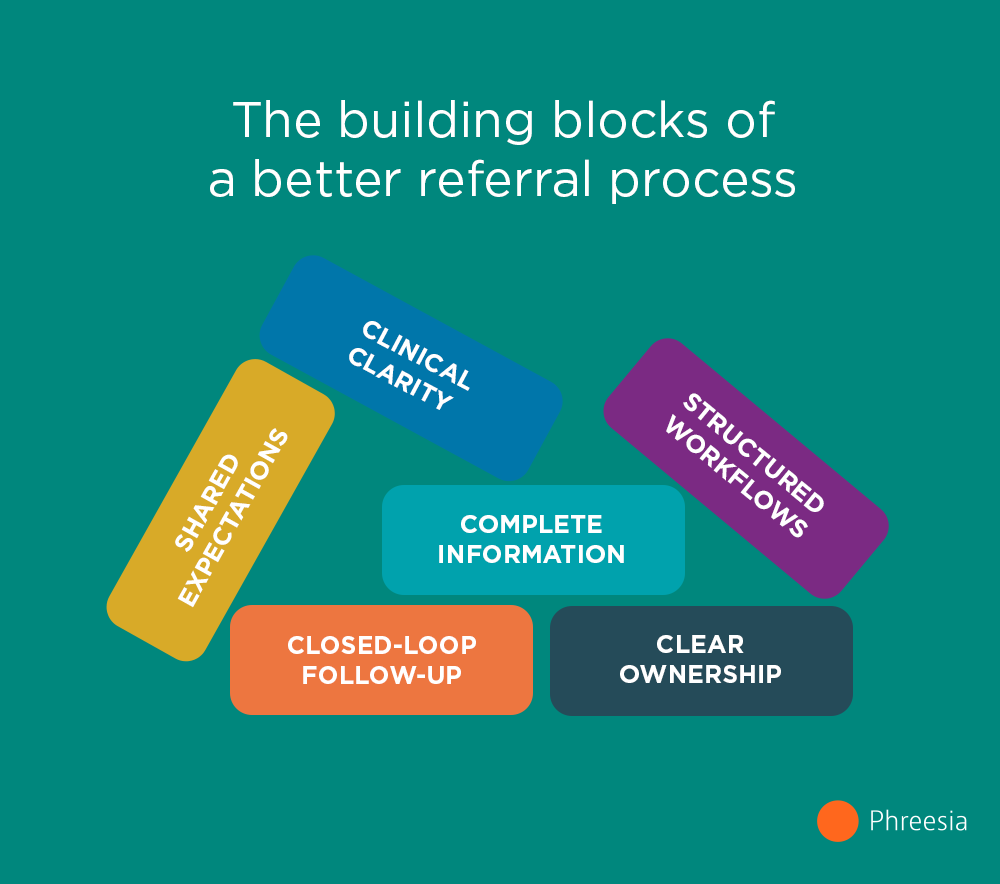
- Start with a clear reason for referral and a specific clinical question: Make it easy for the receiving provider to understand exactly why the patient is being referred. When that’s clear upfront, there’s less need for follow-up and the visit can be more productive from the start.
- Include complete, relevant information upfront: The more complete the referral, the easier it is to act on. Patient history, supporting documentation, insurance details and urgency all help teams move straight to scheduling instead of pausing to track down missing pieces. For instance, “two-way record sharing shows required documents to submit a referral and immediately communicates appointment details when an appointment is made,” says Williamson.
- Define ownership across the process: Referrals move faster when it’s clear who’s responsible for what. That includes who reviews incoming referrals, who schedules the visit and who follows up if something is missing or delayed.
- Set clear expectations for timing and communication: It’s not always clear how quickly referrals should be reviewed or scheduled. Setting clear timelines and keeping communication consistent helps everything move forward more smoothly.
- Make closing the loop part of the workflow: A referral isn’t done when it’s sent. It’s done when the patient is seen and the referring provider gets the information they need. Building that follow-through into the process helps avoid gaps in care.
- Use structured workflows to guide the process: When referrals follow a consistent path, it’s much easier for teams to stay on top of what’s happening and move referrals forward without extra manual work.
Williamson also recommends having at least one physician liaison available to help facilitate referrals. They can address referring providers’ needs to ensure the process runs smoothly–think of them as “a central point of contact for quick questions,” she says.
Build a patient referral program that can be measured and improved
Fixing individual referral issues helps. But lasting improvement comes from treating referrals as a system you can measure, manage and refine over time.
That starts with defining what success looks like. Instead of relying on anecdotal feedback, leading organizations track a few core metrics that reveal how well referrals are actually moving, including:
- Referral conversion rate: how many referrals turn into scheduled visits
- Time to schedule: how quickly patients move from referral to appointment
- Referral completion rate: how many patients are ultimately seen
- No-show and cancellation rates for referred patients
From there, the focus shifts to building workflows(this link opens in new window) that improve both accuracy and efficiency. This stage often includes:
- Standardizing how teams receive and document referrals
- Automating outreach(this link opens in new window) and follow-up to keep patients engaged
- Checking eligibility and requirements before scheduling
- Routing referrals into clear, trackable work queues
Just as important: Don’t let your referral data collect dust in a report. It should actively shape how the process improves over time. For example:
- Are certain referral sources converting at higher rates?
- Where are referrals most likely to stall?
- How long does it take to move from intake to scheduled care?
Over time, this turns referrals from a reactive process into a more predictable growth and access engine. Teams can identify what’s working, fix what isn’t and create a more consistent experience for both patients and providers.
How AI is changing patient referrals
Automation has helped referral teams for years by reducing repetitive manual work. But AI is pushing referral management into a new phase–one where systems can identify patterns, prioritize next steps and help move referrals forward with less manual coordination.
Here’s how that shift is already changing how organizations manage patient referrals(this link opens in new window):
- From tracking referrals to actively moving them forward: Traditional workflows often rely on staff to monitor work queues and manually follow up on stalled referrals. AI can help identify which referrals are missing information, at risk of delays or unlikely to convert into scheduled care so teams can act sooner.
- Smarter referral intake and documentation: Phreesia’s AI-powered fax digitization extracts and organizes information from faxes, uploaded documents and referral forms, reducing manual data entry and flagging missing details before they slow scheduling down.
- More proactive patient outreach: Phreesia VoiceAI automates reminders, follow-ups and scheduling outreach based on where a patient is in the referral process, keeping referrals moving without adding administrative work for staff.
- Better prioritization and routing: AI can help organizations sort referrals based on urgency, specialty, payer requirements or scheduling availability, making it easier to route patients to the right next step faster.
- More visibility into referral performance: AI can analyze referral patterns over time, helping organizations spot bottlenecks, identify high-performing referral sources and better understand where patients tend to drop off in the process.
- More connected workflows across the care journey: Phreesia connects referral workflows with scheduling, intake and patient communication so handoffs are smoother and teams spend less time piecing information together manually.
Frequently asked questions
The patient referral process is how patients get connected to the next step in their care. It usually starts when a provider identifies a need–like seeing a specialist–and ends when the patient is scheduled, seen and that information is shared back with the referring provider.
Patient referrals usually fall through because of breakdowns in the process. Common issues include unclear next steps, missing information, lack of follow-up and fragmented workflows. When no one owns the next step–or when patients are expected to manage too much on their own–it’s easy for referrals to stall before care happens.
It often comes down to making the process easier for everyone involved. That can involve strengthening relationships with referring providers, standardizing workflows, improving communication or making it simpler for patients to schedule and follow through. Tracking referral performance can also help teams see what’s working and where there’s room to improve.
At a minimum, a medical referral should clearly explain why the patient is being referred and what the receiving provider needs to evaluate. It should also include relevant patient history, supporting documentation, insurance details and any notes on urgency. The more complete it is upfront, the faster it can move forward.
Most referrals fall into one of three categories:
- Routine referrals, which are non-urgent and scheduled in advance
- Urgent referrals, which need to be addressed more quickly due to potential health risks
- Emergent referrals, which require immediate attention, often in emergency settings
Understanding the type of referral helps teams prioritize scheduling and ensure patients get the right level of care at the right time.
Conclusion
Patient referrals work best when the process is clear, connected and easy to move through. Most gains come from fixing the everyday friction points, like inconsistent decisions, unclear ownership and disconnected workflows. Once those are smoothed out, referrals move more predictably, patients get scheduled faster and teams spend less time chasing what’s missing.
The next step is building a referral system you can actually improve over time. With better visibility, more structured workflows and data that’s put to use, it becomes easier to keep refining the process. That way, teams can keep the ball rolling so patients get timely care.
A version of this article was originally published on March 14, 2022.


