
In today’s digital world, many patients use their smartphones or other devices to manage their lives. With the tap of a few buttons, they can make a restaurant reservation, pay for parking, check in for a flight or schedule a salon appointment, all from the comfort of their couch.
Healthcare should be no different. Patients often think about their health needs outside of regular business hours. And they want the convenience of scheduling or rescheduling an appointment from anywhere and at any time.
A March 2021 Phreesia survey(this link opens in new window) on health-technology preferences given to more than 4,000 patients checking in on Phreesia’s intake platform found that a growing number of patients are comfortable using digital communication tools in healthcare settings. Among those, text messaging is an easy way to digitally expand patient interactions.
This article explores four reasons why two-way text messaging software is a must-have for healthcare practices: Two-way text messaging improves response rates, provides convenience for patients, eases staff burden and delivers scalable outreach and follow-up.
Why two-way text messaging software matters for healthcare organizations
Two-way text messaging software in healthcare provides a secure method for providers and patients to communicate in real time via Short Message Service (SMS).
However, two-way text messaging isn’t just about quick communication or SMS marketing. It serves as a communication workflow tool. The benefits go both ways by offering convenience for patients and efficiency for healthcare workers.
“I use two-way texting in my own practice, and it is a game changer,” says Mikel Daniels, DPM, MBA(this link opens in new window), the founder and lead practitioner of WeTreatFeet Podiatry. “No patients waiting on hold or playing phone tag. Just a simple text back and forth.”
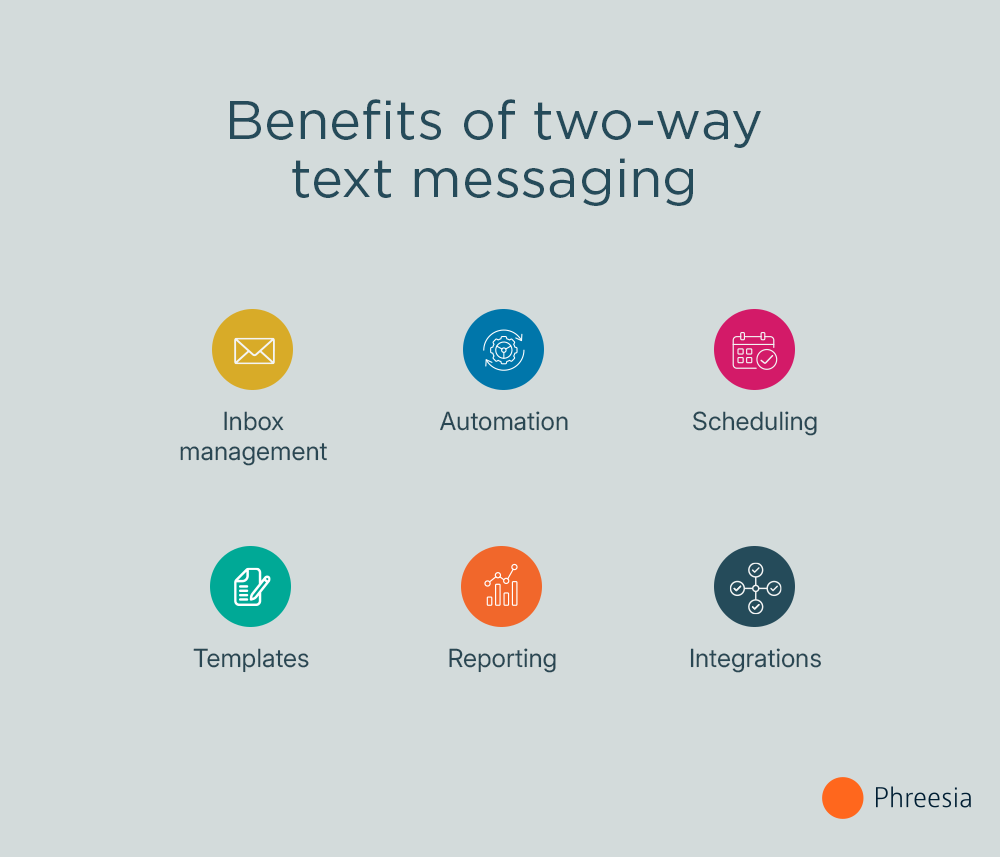
Benefits of two-way text messaging:
- Inbox management: Patient messages are centralized in one organized workspace.
- Automation: Automated outreach manages reminders, follow-ups and patient tasks.
- Scheduling: Patients can book, confirm or reschedule appointments at their convenience without having to call staff during office hours.
- Templates: Communication can be standardized with messaging templates for reminders, patient paperwork and more.
- Reporting: Message performance, response rates and the like can be tracked, delivering helpful metrics.
- Integrations: Messaging can sync with other workflow tools for robust management.
Reason 1: Meet patients faster in a more convenient channel
Text messaging is easier for patients than playing phone tag or managing emails. Patients are used to being able to schedule or manage many processes in their daily lives by tapping on their smartphones. Email inboxes get clogged with work and other laborious tasks, along with spam. Text messaging is a more urgent and convenient channel for front-and-center communication.
“Most of my patients simply do not want to answer the phone,” Dr. Daniels says. “This is especially true when they are at work, driving or juggling kids. Sending texts lets them respond on their own time without waiting on hold or playing phone tag.”
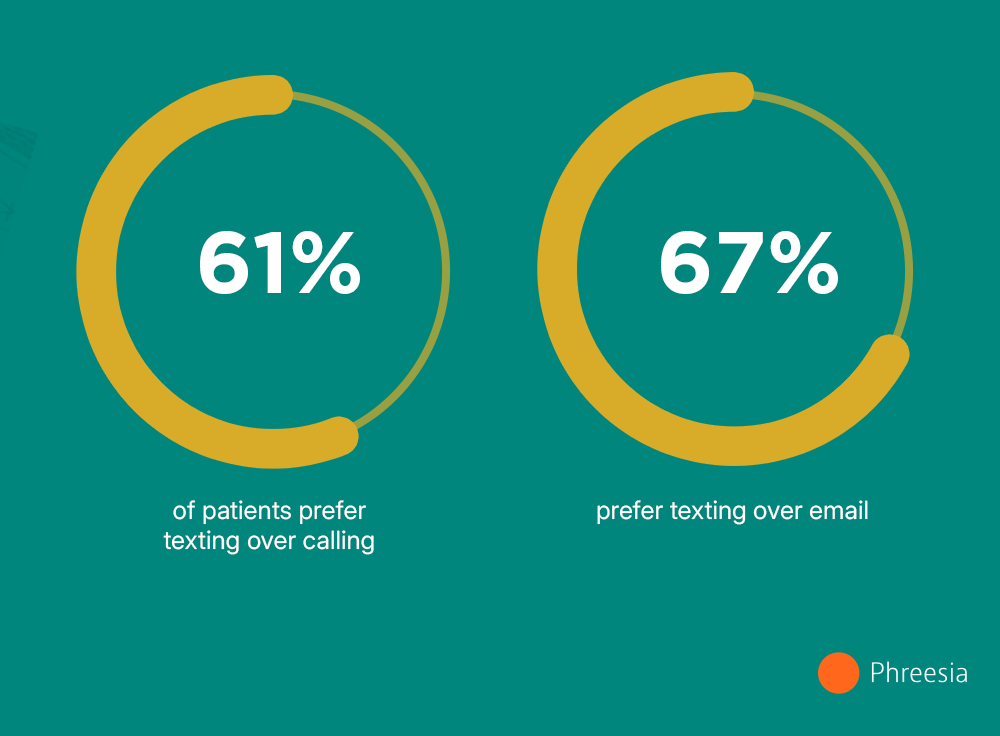
Indeed, a 2022 study in the European Journal of Emergency Medicine(this link opens in new window) found that 61% of patients prefer texting over calling, and 67% prefer texting over email.
Daniels has witnessed this convenience firsthand. “In our WeTreatFeet offices, I see that a quick text reply, ‘Yes I can come at 2:30 instead,’ fits into their day much better than stepping out of a meeting to take a call. Plus, like any growing business using a VOIP system, we have dropped calls. Each one of those costs us business.”
Texting is especially preferred for patients under age 60, according to the 2022 study.
“For younger patients and busy professionals,” Dr. Daniels says, “their entire life is already organized through their phone’s messages, so having the practice communicate in that same channel just feels natural, where speaking on the phone has become difficult for some.”
Reason 2: Turn reminders into real conversations
Texting can help facilitate conversational messaging between providers and patients.
“Texting also feels lower-pressure than a phone call,” Dr. Daniels explains. “Patients are more likely to ask ‘small’ questions they would otherwise sit on, and in a more time-advantaged fashion.”
The time advantage benefits the provider as well, as texting helps facilitate more concise communication. As Dr. Daniels notes, patients summarize their questions and needs via text. Phone calls can lead to lengthy conversations that unnecessarily tie up provider time.
Plus, texting aids with faster care where needed. “This lets us intervene sooner, and keep problems from turning into ER visits,” he explains.
Patient convenience:
- Confirmations and changes or cancellations: Patients can manage their appointments at their own convenience without tasking staff.
- Callback requests: If a patient needs to talk through their concern on the phone, they can request a callback without having to wait on hold.
- Basic questions: Patients can send quick questions or requests that don’t require an appointment.
- Next steps: When next steps appear via text message rather than only on discharge paperwork or patient portals, patients may be more likely to follow through on care tasks.
Reason 3: Reduce staff phone volume and scheduling friction
As a 2022 Phreesia study found, patients are demanding more convenient ways to manage their healthcare, but the convenience also extends to front-of-office staff who traditionally have to manage phone calls, callbacks and more. A staff member freed of excess calls can devote more attention to ensuring a positive patient experience.
“On the staff side,” Dr. Daniels says, “two-way texting cuts down the endless back-and-forth that eats up front-desk time and clogs the phone lines. Spending a large chunk of time scheduling, asking simple questions, getting demographics and confirmation of appointments is just not productive. Two-way texting solves most of these issues.”
A lower overall call volume also reduces complications in call management, such as long hold times that lead patients to hang up and dropped calls caused by tech issues. “We have so many abandoned calls,” he adds, “and each one of those is potentially lost business.”
Staff members not stuck on calls can also serve more patients at once. “My own team loves being able to handle multiple patient conversations in parallel, instead of being stuck on one phone call at a time,” Dr. Daniels says. “My staff can answer a refill question, confirm tomorrow’s surgical time and send directions to a new patient in the same five-minute window, which is impossible by phone.”
Two-way texting presents the advantage of clear, consistent messaging with fewer errors. “Most of the common questions [and answers] are templated out, so they just need to click the template, no actual typing needed,” Dr. Daniels explains.
Texting also helps reduce errors. Patients can add texted appointment dates directly to their smartphone calendars with a tap of a few buttons, and the same date, time and location ends up on the practice’s schedule.
“We archive message histories,” Dr. Daniels says, “and that gives us a clear record of what was said and when. For a multi-location practice like WeTreatFeet, this matters a lot when patients bounce between sites, or when call notes get lost in the shuffle.”
Reason 4: Scale outreach, personalization and follow-up
Two-way text messaging aids communication workflows beyond just addressing scheduling hassles.
“The real value shows up when you stop thinking of texting as just reminders and start using it as a full patient communication tool,” Dr. Daniels says. “We can verify insurance, send links to forms, share parking/entrance instructions and confirm which shoe gear or paperwork they should bring. We can also get images of insurance cards and IDs.”
Care outreach is another benefit. “We can send brief dressing reminders, non-weight-bearing reminders or ‘Did you pick up your antibiotic?’ check-ins, which improve adherence and outcomes.”
Plus, practices can send educational campaigns that reach patients right on their phones, where they are potentially more likely to engage with the content. “We can send out short, targeted education bursts about fall risk, diabetic shoes or post-procedure care instead of dense emails that nobody reads,” he adds.
Outreach benefits:
- Broadcasted updates: Clinic updates, such as bad weather protocols and more can be sent to relevant patients.
- Personalized reminders: Personalized reminders help facilitate “last mile of care” initiatives.
- Educational campaigns: Patients can read relevant educational content from the convenience of their devices.
- Surveys: Survey tools provide valuable feedback.
- Post-visit outreach: Providers and staff can add additional patient communication touchpoints as needed.
What to look for in a two-way messaging software
If your practice is looking for third-party, two-way SMS software, you might be wondering what features are essential.
“Today, any digital tool has to pass one test,” Dr. Daniels says. “Does it make care better, cheaper and faster for real patients in real offices? A good two-way SMS platform can do that if it is chosen and implemented thoughtfully.”
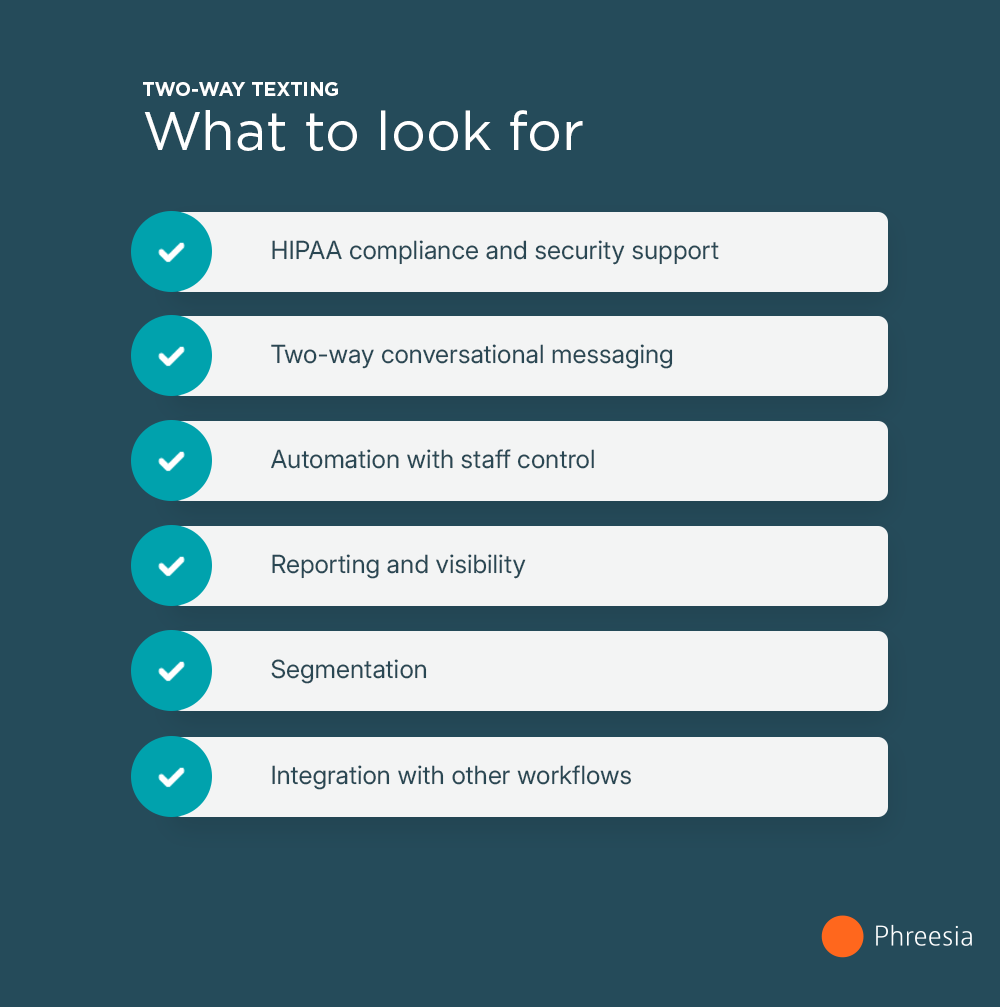
What to look for:
- HIPAA compliance and security support
- Two-way conversational messaging
- Automation with staff control
- Reporting and visibility
- Segmentation
- Integration with other workflows
- Ease of use for staff and patients
How AI is changing two-way text messaging
Two-way text messaging has been enhancing convenience for patients and staff for some time now. However, AI tools have elevated the process with real-time automation.
- Patient support 24/7: AI can handle common questions anytime.
- More personalized conversations: AI can customize messages based on patient history, preference and past behavior.
- Smarter appointment management: Patients can schedule, reschedule, get on a waiting list and confirm appointments from their mobile devices with the help of AI.
- Improved staff efficiency: AI handles and streamlines repetitive tasks, allowing staff to focus on higher-value patient support.
- Multilingual communication: AI can tailor messages to a patient’s preferred language.
- Actionable insights and reporting: AI analyzes and identifies trends, concerns and opportunities to improve outreach or processes.
Frequently asked questions
Two-way text messaging software in healthcare allows patients to schedule, reschedule or cancel appointments by sending simple texts to their provider’s office. It also allows patients to ask quick care follow-up questions as needed. For staff, it helps streamline workflows by sending messages in the way most patients prefer, reducing call volume.
SMS marketing involves one-way text messaging of campaigns and other communications. In contrast, two-way texting allows patients to communicate with their providers and front-of-office staff without time-consuming calls or phone tag.
Yes, two-way text messaging helps reduce phone calls and frees up staff to get more done while focusing on patient experience and satisfaction.


