🚀 EARLY ACCESS
Give patients a better experience with Quiet Hours
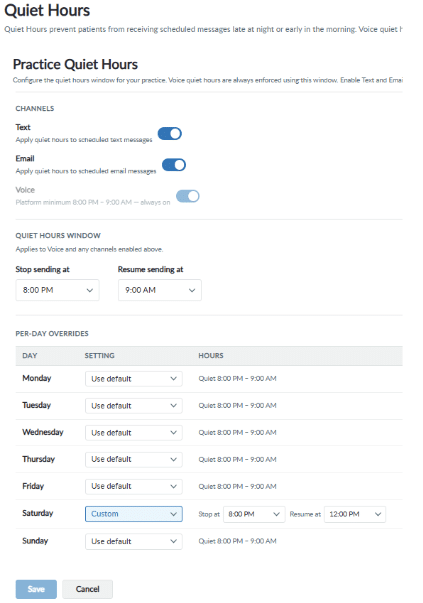

What’s new: Quiet Hours gives organizations more control over when Appointment Confirmations and Previsit communications are sent. Messages scheduled during configured quiet hours are held until that period ends.
How this helps you: Prevent non-urgent communications from reaching patients too early in the morning, on weekends or at other times your organization considers inappropriate. Quiet Hours gives you greater control over the timing of your outreach and can help create a more thoughtful patient communication experience.
🚀 FEATURED
Enhance the patient calling experience with VoiceAI
What’s new: Phreesia VoiceAI now offers a more natural and reliable calling experience. Patients can expect faster responses, more natural-sounding conversations, and more consistent support from start to finish.
How this helps you: Patients get a smoother, more conversational calling experience, while your organization benefits from more reliable call outcomes across VoiceAI use cases.
Help patients reschedule appointments with VoiceAI
What’s new: VoiceAI can now help patients at eligible athena organizations reschedule appointments by phone. VoiceAI verifies the patient, confirms the existing appointment, finds a new time, updates the schedule in athena and sends an SMS confirmation, all within the same interaction.
How this helps you: Rescheduling makes up roughly 10% of inbound calls. VoiceAI handles these requests without staff involvement, giving patients a faster way to reschedule and giving your front desk more time back.
Get more from the new Phreesia Analytics experience

What’s new: Phreesia is introducing a new Analytics experience designed to make it easier to understand performance, explore trends, and find the information your team needs. The updated experience includes new navigation, refreshed report layouts, metric tiles, filters, and consolidated reporting views. In-app guides will also help users get oriented as they begin using the new experience.
How this helps you: The new Analytics experience is designed to make reporting easier to navigate and insights easier to use. Because the experience is changing, your team may need some time to get familiar with the new layout and workflows. In-app guidance will be available to help users adjust and start using the new reports with less training or support.
Eligibility & Benefits
Get in-app help resolving Medicare attestation errors

What’s new: A new Medicare Attestation Required in-app guide will appear when a Medicare eligibility check returns AAA status code 41 because Medicare attestation with CMS has not been completed. The guide gives staff two clear paths forward: learn how to complete Medicare attestation or indicate that the organization does not participate in Medicare.
How this helps you: Staff can identify the likely cause and appropriate next step directly within Phreesia instead of relying on the error message alone or opening a support ticket. That can help shorten time to resolution and get affected eligibility checks back on track faster.
Next step: This enhancement is automatically available for all organizations using Phreesia Eligibility & Benefits.
Payments
Reduce duplicate payment risk for patients using scheduled payments
What’s new: When a bill is approved in Bill Pay and a scheduled payment is created, Phreesia can now suppress the Initial Notice in the dunning sequence. The patient receives the scheduled-payment pre-charge notification instead, while subsequent reminders can still be sent if the bill remains unpaid.
How this helps you: This update helps reduce the risk that a patient manually pays after receiving an Initial Notice and is then charged again through their scheduled payment. That means fewer duplicate payments, less refund-processing work, and a simpler communication experience for patients.
Phreesia Content Library
Phreesia offers a library of standardized tools and best-practice content designed to align with industry recommendations and increase completion rates. These pre-built modules can be seamlessly added to your existing intake workflows. Organizations that use these modules see a 9.5% lower drop rate, and patients complete interviews 48.8% faster compared to custom content.
We deploy new and updated content with every release.
Standardized tools
We now offer the following clinically validated patient-reported outcomes (PROs).
COVID-19 Vaccine Confidence and Access
A WHO-aligned assessment that measures patient vaccine confidence, hesitancy drivers, and access barriers across three domains, available in a full 15-question version and a concise 8-question version. Gives care teams structured insight to guide outreach and patient conversations about vaccination.
Overactive Bladder Symptom Score (OABSS)
A validated seven-item patient-reported questionnaire that assesses overactive bladder symptom severity, including daytime frequency, nocturia, urinary urgency, urgency incontinence and perceived bladder control. The OABSS gives clinicians a standardized way to measure symptom burden and monitor changes over time.
Brief Addiction Monitor (BAM)
A validated 17-item patient-reported monitoring tool for individuals receiving treatment for substance use disorders. The BAM tracks substance use, risk factors and protective factors across visits, supporting measurement-based care and helping clinicians better understand a patient’s recovery progress.
Screening to Brief Intervention (S2BI)
A validated, NIDA-endorsed adolescent substance use screening tool that uses past-year frequency of tobacco, alcohol and marijuana use to categorize patients into No Reported Use, Lower Risk or Higher Risk. S2BI helps organizations standardize adolescent substance use screening, identify at-risk patients earlier and support brief intervention and referral-to-treatment workflows.